
Protein Expression & Detection
From high-sensitivity detection to spatial localization — a complete solution for precisely quantifying target protein expression.
Western Blot
Western blot (WB) is among the most common protein-analysis techniques in molecular biology, biochemistry, and clinical medicine, used to detect specific protein expression levels, verify molecular weight, and analyze modifications (e.g., phosphorylation, acetylation). With high specificity and sensitivity it is indispensable for protein-expression studies. WB serves basic research (validating gene products, protein interactions, pathway activation) and clinical testing (tumor markers, pathogen screening, disease typing). Unlike other methods, WB delivers both qualitative and semi-quantitative results, earning it the "gold standard" of protein-expression analysis.
Principle Introduction
WB is based on antigen–antibody specificity combined with gel electrophoresis and signal amplification for qualitative/semi-quantitative analysis and MW verification. The target protein (antigen) has unique epitopes binding a specific primary antibody to form an antigen–antibody complex. A labeled secondary antibody recognizes the primary's constant region, building a target-primary-secondary ternary complex. The secondary is labeled with an enzyme (HRP, AP) or fluorophore; enzyme labels catalyze a chemiluminescent substrate (e.g., ECL), fluorophores emit directly. Signal presence, intensity, and position reveal whether the target exists, its expression level, and its molecular weight.
Literature
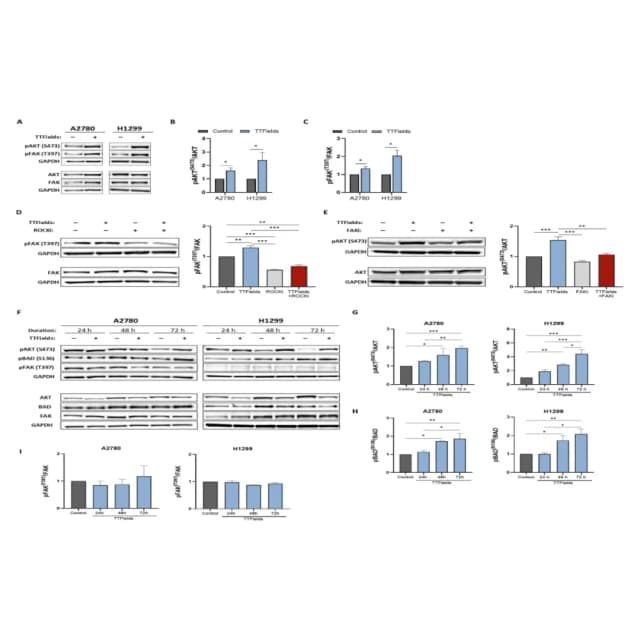
cell death & disease published "Role of the PI3K/AKT signaling pathway in the cellular response to Tumor Treating Fields (TTFields)." Using human glioblastoma U87 cells with control, TTFields-only, and PI3K-inhibitor-plus-TTFields groups, WB detected PI3K/AKT-pathway and autophagy/apoptosis proteins. TTFields alone significantly down-regulated p-PI3K, p-AKT, and mTOR while raising LC3-II/LC3-I and activated Caspase-3; adding PI3K inhibitor deepened these changes and apoptosis, indicating PI3K/AKT inhibition sensitizes tumors to TTFields. WB precisely verified PI3K/AKT activity correlates with TTFields response, supporting targeted PI3K/AKT enhancement of TTFields efficacy.
Sample Requirements
≥500ng/μL, ≥50μL, -20℃, cold pack; attach sequencing report and vector map.
fresh leaf/callus >1g/sample, 4℃ cold transport, arrive within 24h; note variety and growth state.
cryopreserved cells with viability >90%, dry ice; fresh protoplasts, cold pack, within 12h; note cell type and culture conditions.
bait/prey sequences (FASTA), specify restriction sites and fusion orientation.
Deliverables
Raw data
original WB films (target and loading control bands), grayscale raw data, electrophoresis/transfer parameters.
Analysis report
MW verification, grayscale statistics (target/loading ratio), semi-quantitative conclusion, interpretation.
FAQ
① degradation (add protease inhibitors, keep cold); ② wrong gel % (higher for small proteins); ③ overload (reduce load); ④ high primary concentration (lower, extend blocking).
optimize blocking (milk→BSA), lower/shorten primary incubation or raise temperature, wash more with TBST, use monoclonal antibody.
equal loads via accurate quantification, check antibody specificity, optimize electrophoresis/transfer, re-extract if needed.
