Protein Expression & Detection
From high-sensitivity detection to spatial localization — a complete solution for precisely quantifying target protein expression.
Protein Pull-Down Assay
Pull-Down is a classic in vitro technique for protein interactions based on antigen–antibody or tag–ligand binding. It captures prey proteins interacting with a bait directly from lysates or mixtures, overcoming Co-IP's dependence on specific antibodies and difficulty with low-abundance proteins. Simple, specific, and intuitive, it needs no intracellular environment and flexibly controls conditions—validating known direct interactions and screening unknown partners by MS, widely used in signaling, complex composition, and drug-target screening.
Principle Introduction
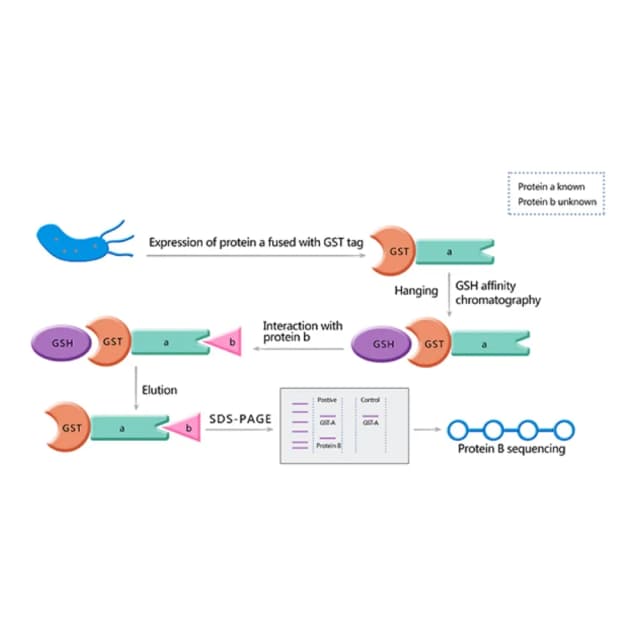
Pull-Down immobilizes a tagged bait protein (His/GST/Flag) on a solid support via tag–ligand binding, captures interacting prey from the sample, and verifies the interaction. Build and purify the tagged bait; incubate with the matching support (GSH beads for GST, Ni-NTA for His) to form bait-support complex; add prey-containing sample and incubate; wash away non-specific proteins; elute the ternary complex; detect known prey by Western blot or identify unknown prey by MS.
Literature
Nature Communications published "OsMAPK6 phosphorylation and CLG1 ubiquitylation of GW6a non-additively enhance rice grain size through stabilization of the substrate," revealing grain-size control. The authors hypothesized that kinase OsMAPK6 phosphorylates positive regulator GW6a. For direct interaction, GST Pull-Down used purified GST-OsMAPK6 and MBP-GW6a; after immobilizing GST-OsMAPK6 on beads and incubating with MBP-GW6a, WB detected MBP-GW6a in eluate but not in empty-GST control, confirming in vitro direct interaction. In planta, co-expressing OsMAPK6-GFP and GW6a-Myc and IP with anti-GFP detected Myc, showing complex formation. With phosphorylation data, they showed OsMAPK6 directly phosphorylates GW6a to stabilize it, coordinately regulating grain development.
Sample Requirements
≥0.5mg/mL, ≥200μL, purity >80%, -80℃, dry ice; note tag type (GST/His/Flag) and purity report.
≥1mg/mL, ≥1mL, -80℃, dry ice; note cell line and condition, no degradation.
>1g/sample, snap-frozen -80℃, dry ice; specify tissue, avoid thaw.
≥0.3mg/mL, ≥100μL, -80℃, dry ice; provide activity report.
≥500ng/μL, ≥50μL, -20℃, cold pack; provide map and sequence.
Deliverables
Pull-Down raw data
WB maps of Input, negative control, Pull-Down; band grayscale quantification.
Interaction report
conclusion on direct interaction, false-positive exclusion, band comparison.
Technical documentation
optimization tips (buffer, concentration), troubleshooting; for MS, protein ID list and bioinformatics report.
FAQ
① block with 1% BSA or milk; ② wash more (5–6×) or raise salt; ③ spin prey to remove aggregates; ④ purify bait further.
① more bait on support, 4h; ② more prey; ③ stronger eluent (glutathione, imidazole); ④ more sensitive antibody or ECL enhancer.
① use purified recombinant proteins; ② truncation mapping; ③ combine with BiFC.
