
Protein Expression & Detection
From high-sensitivity detection to spatial localization — a complete solution for precisely quantifying target protein expression.
Yeast Two-Hybrid (Y2H)
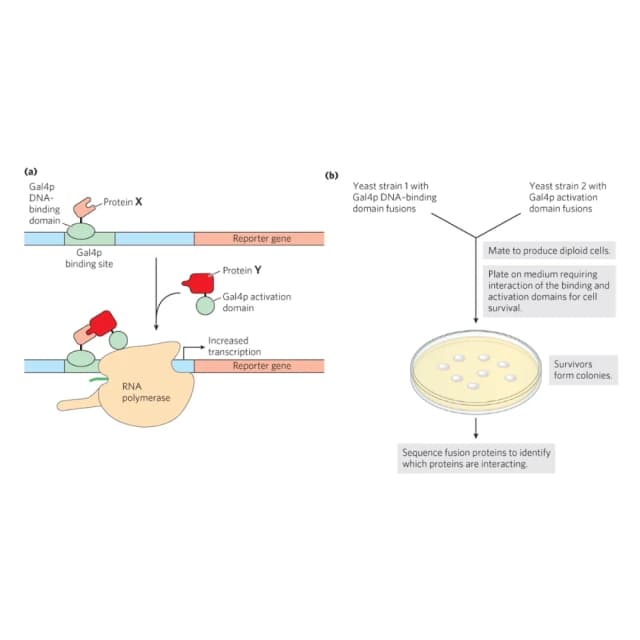
Yeast two-hybrid (Y2H) is a classic method studying protein interactions in yeast based on separation and reconstruction of transcription-factor domains. It overcomes in vitro assays' inability to mimic the cellular environment, validating interactions in living cells with high specificity, sensitivity, simplicity, and low cost. Y2H verifies known interactions and screens unknown partners from cDNA libraries, widely used in signaling, complex composition, and disease mechanisms. Unlike Co-IP, it needs no purified protein or antibody and rapidly screens many candidates, making it an efficient discovery tool.
Principle Introduction
The core principle uses a eukaryotic transcription factor (e.g., GAL4) whose N-terminus is a DNA-binding domain (BD, 147 aa) and C-terminus an activation domain (AD, 113 aa). BD binds UAS; AD activates downstream transcription. Neither alone activates transcription; only together do they form a functional activator. Protein interaction reconstructions BD and AD, activating a reporter gene whose phenotype validates the interaction.
Literature
Cellular and Molecular Gastroenterology and Hepatology published "Hepatocyte Stress Increases Expression of YAP and TAZ and Promotes Fibrosis Through a Yes-Associated Protein-Transcriptional Enhanced Associate Domain–Dependent Mechanism." To find how hepatocyte stress drives fibrosis via YAP/TAZ, they used Y2H screening with full-length human YAP as bait against a liver cDNA library, identifying TEAD4 as a strong YAP interactor. This linked stress signals to the known YAP-TEAD complex; in vivo validation (Co-IP) confirmed the interaction in mammalian cells, and TEAD4 knockout in mouse hepatocytes markedly reduced drug-induced fibrosis—showing Y2H as a discovery engine that, from a bait, locks its prey and reveals the YAP-TEAD4 pair's role in fibrosis, suggesting a therapeutic target.
Sample Requirements
FASTA; plasmid ≥500ng/μL, ≥50μL, -20℃, cold pack; attach sequencing.
same as bait; cDNA library needs concentration (≥100ng/μL), complexity, insert length.
qualified strains (Y2HGold, AH109), -80℃ glycerol stock, dry ice; note genotype and marker.
>1g/sample, snap-frozen -80℃, dry ice; note type and condition (stress, stage).
Deliverables
Self-activation and toxicity report
bait self-activation (growth/color), toxicity (colony state).
Co-transformation and screening report
growth/color photos on dropout media, positive/negative calls.
Technical documentation
optimization tips (self-activation removal, toxicity relief), false-positive/negative guide; for library screening, prey sequences and functional annotation.
FAQ
① weak interaction (extend to 5–7 d, lower 3-AT); ② no expression (WB verify, optimize vector); ③ PTM dependence (combine Pull-down); ④ low co-transformation efficiency.
① weaker promoter or inducible promoter; ② truncation removing toxic domain; ③ 28℃ or longer culture; ④ switch strain (AH109).
① retransform bait+prey (retransform); ② in vitro Pull-down with purified proteins; ③ in vivo Co-IP or split-luciferase.
