Microbiomics
Deeply characterize host and environmental microbial communities to reveal the complex interplay between microbiota and health.
Bacterial De Novo Sequencing
Bacterial genome de novo sequencing obtains and assembles the complete bacterial genome without a reference, resolving the full genetic information of unknown or unannotated bacteria. Its value spans basic research, clinical application and industrial/environmental use. Traditional short-read sequencing (50–300 bp) struggles to span repeats, leaving assembly gaps and missing plasmids/phages. Long-read breakthroughs now enable complete circular finished genomes, making de novo a core tool from sequence to function.
Principle Introduction
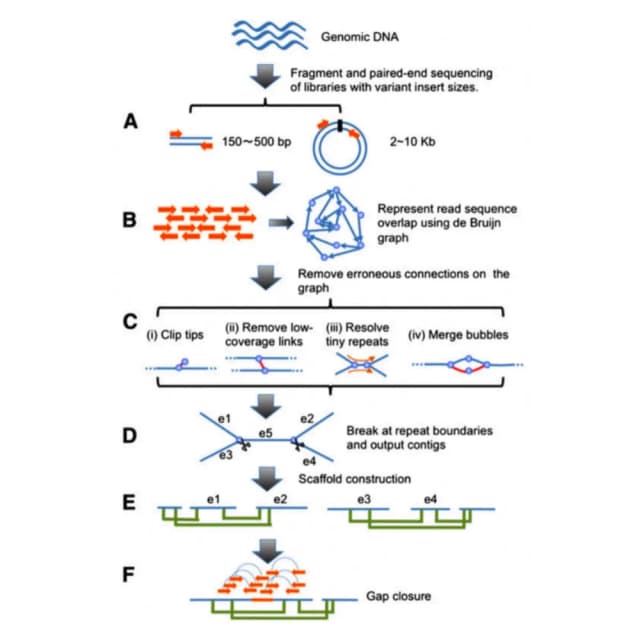
The core is multi-technology complementarity: long reads for contiguity, short reads for accuracy, auxiliary techniques for genetic elements, yielding a complete genome. Chromosomal DNA is randomly sheared, libraries built per strategy and sequenced at scale. Assembly level depends on need and species; the top goal is one contig = complete genome. Annotation predicts ORFs, checks functional sites and interactions. De novo replaces traditional methods for bacterial evolution, key genes, pathogen virulence, vaccine/antibiotic development and intraspecies evolution.
Literature
Published in nature microbiology, "Host-derived organic acids enable gut colonization of the honey bee symbiont Snodgrassella alvi" isolated 12 bacteria from western honey bee (Apis mellifera) gut—Bartonella, Bifidobacterium, Lactobacillus and opportunistic Serratia marcescens KZ11. Using Oxford Nanopore with Flye for de novo assembly and gap-filling of 6 draft genomes: 10 achieved >130× circular chromosomes gap-free; 2 closed remaining gaps manually (Geneious Prime + Minimap2); Lactobacillus apis K-mp7 added Illumina short reads for completion. Metabolic (vitamin B synthesis) and virulence genes were resolved, providing complete references for bee gut symbiont research and a nanopore-led, short-read-assisted completion pipeline.
Sample Requirements
total cells ≥10^9.
≥2 mL (liquid) or ≥0.5 g (solid).
≥1 μg.
Deliverables
Assembly
core files, genome sequence, QC report, circular genome map (GC, gene density, plasmid position), contig length distribution.
Annotation
gene structure, functional and non-coding RNA annotation.
Report
basic module (QC, assembly validation); advanced module (comparative genomics, functional enrichment, evolution).
FAQ
Improved MDA: high-fidelity Phi29 polymerase (error<10⁻⁶); low-temp slow amplification (30°C, 16 h); algorithmic filtering of low-copy biased fragments; core-gene coverage validation (<10% error).
Three checks: 100–500 bp end overlap; PCR across the junction; uniform coverage (plasmid = chromosome).
Plasmids are mobile elements carrying resistance, virulence and metabolic genes—key to adaptability and engineering; annotate separately for location and transfer potential.
