Microbiomics
Deeply characterize host and environmental microbial communities to reveal the complex interplay between microbiota and health.
16S/ITS/18S Amplicon Sequencing
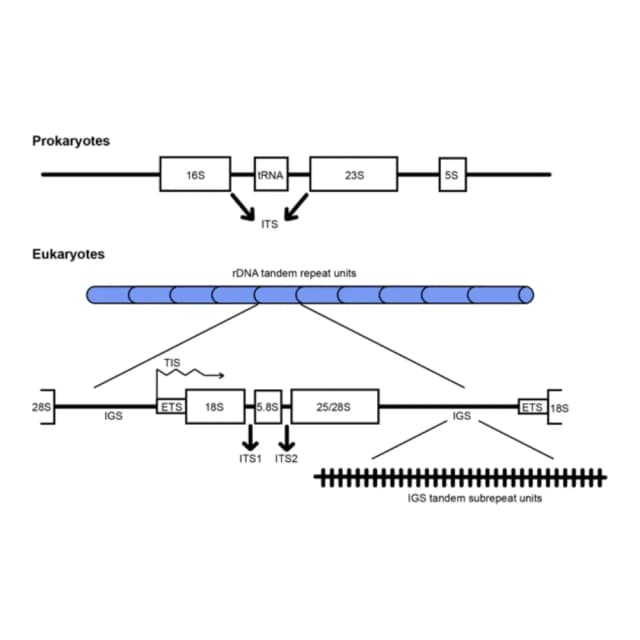
Microbial diversity sequencing, also called amplicon sequencing, efficiently resolves microbial community composition in complex environments. Total DNA is extracted from environmental samples (soil, water, gut content) and universal primers amplify hypervariable regions of marker genes—16S rDNA (bacteria/archaea), 18S rDNA (eukaryotes) or ITS (fungi)—followed by high-throughput sequencing to reveal species composition, abundance and diversity. Conserved regions enable primer design for broad amplification; hypervariable regions serve as molecular barcodes for species identification. V3–V4 of 16S is common for bacteria/archaea; 18S for eukaryotes; ITS1/ITS2 (fast-evolving) for fungi.
Principle Introduction
The amplicon workflow starts with PCR: qualified genomic DNA is amplified with fusion primers under set conditions, then purified to remove primers/enzymes and form the library. QC measures fragment size and concentration before sequencing. Downstream data are strictly QC'd—filter low-quality reads to Clean Data, merge paired reads by overlap into longer Tags, then cluster Tags into OTUs at 97% similarity (each ~one species). OTUs are annotated against databases; α and β diversity quantify within-sample complexity and between-group differences. Standardized operations resolve environmental community structure.
Literature
Published in Science, "Gut microbiome heritability is near-universal but environmentally contingent" explored host genetic effects on the gut microbiome. Using 14 years of longitudinal data (16,234 fecal samples from 585 wild baboons, Papio cynocephalus) and 16S rRNA sequencing, it assessed microbial diversity heritability. 16S V4 amplicon sequencing generated ASV data quantifying relative abundance, α diversity (Shannon) and β diversity (Bray-Curtis). It showed gut microbiome heritability is near-universal in baboons but highly environment-dependent, evidencing the microbiome as a host phenotype under selection and stressing longitudinal sampling.
Sample Requirements
≥0.5 g.
≥0.5 mL.
≥0.5 g.
≥0.3 g.
≥1 mL, precipitate ≥0.5 g.
≥1 mL, precipitate ≥0.5 g.
≥1.
≥8 mL or ≥4 g.
≥0.5 g.
≥1.
≥1.
Deliverables
QC report
Q30, depth, length distribution and valid read count after filtering.
ASV/OTU table
amplicon sequence variants or operational taxonomic units with per-sample abundance.
Denoising & chimera removal
tools reduce PCR and sequencing errors.
Diversity analysis
alpha, beta diversity and statistical tests.
Taxonomic annotation
assignment against reference DBs; composition plots of relative abundance.
Advanced analysis & report
differential abundance; optional functional prediction (e.g., PICRUSt2).
FAQ
ITS targets fungi with high annotation accuracy; 18S covers eukaryotes broadly but lower fungal precision—choose by goal.
More samples improve statistics. Minimum: intra-sample diversity n≥4; inter-group diversity groups≥2 with n≥3 each.
16S amplicons exclude host info, so host DNA does not affect results and no extra data needed.
