Microbiomics
Deeply characterize host and environmental microbial communities to reveal the complex interplay between microbiota and health.
Microbial Whole-Genome Resequencing
Microbial resequencing deeply and precisely sequences the genome of microbes (bacteria, fungi, viruses) with a known reference. Its hallmark is reference-based analysis—no de novo assembly—focusing on variant resolution and functional association. Microbial genomes range 0.5–10 Mb (bacteria) to tens of Mb (fungi); >90% is functional-gene related, driving phenotypic differences. Versus de novo, MWGS cuts cost 60–80%, speeds analysis 5–10×, reaches 50×–500× depth and captures low-frequency variants—now core for typing/tracing, resistance mechanisms, clinical diagnostics and surveillance, especially large-cohort strain monitoring and evolution.
Principle Introduction
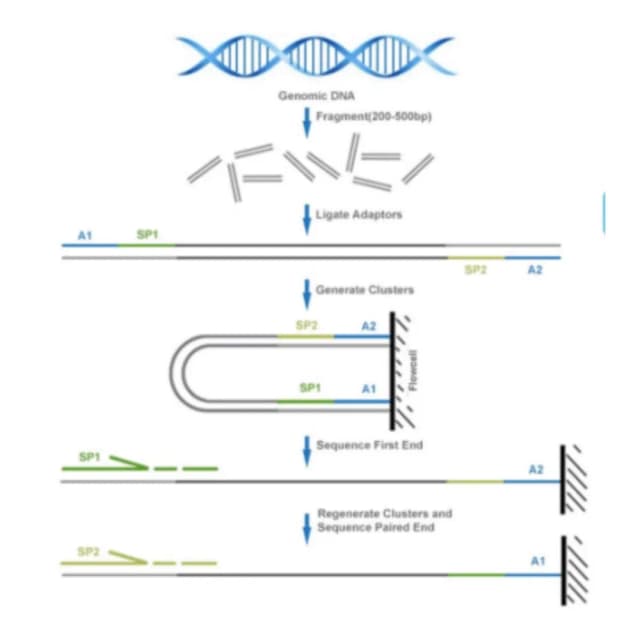
The core is reference alignment plus precise variant calling: sample processing and DNA extraction from pure cultures, clinical or environmental samples; library construction (random 200–500 bp fragments with adapters/indexes); high-throughput sequencing with depth by goal; alignment and QC (map reads to the reference, filter low-quality, duplicates and host contamination); variant detection and annotation (SNP, InDel, CNV, HGT) with functional databases linking phenotypes. The "variant-focused, deep-coverage" strategy delivers low-cost, efficient resolution for downstream validation.
Literature
Published in Nature Genetics, "Insights into Yersinia pestis evolution through rearrangement analysis of 242 complete genomes" used MWGS on 242 Yersinia pestis genomes, identifying 459 rearrangements across 426 synteny blocks. Rearrangements were mediated mainly by 4 insertion sequences (IS; >90%), with IS1661 and IS100 most active; 43 rearrangement hotspots (e.g., rpsO-pnp operon for temperature stress) were positively selected. It resolved stepwise rearrangements in Branch 1/2, clarified the multi-branch 1.ORI (third pandemic) structure, found low-virulence populations (0.PE4B, 0.PE4C) with distinct patterns (3 genes inactivated, 17 intergenic rearrangements) possibly lowering pathogenicity, and showed rpsO-pnp rearrangement affects temperature-stress response—revealing rearrangement roles in adaptation.
Sample Requirements
bacterial/fungal ≥1×10^8 CFU.
sputum, pus, CSF, blood (pathogen isolated) ≥2 mL (liquid) or ≥0.2 g (solid).
soil ≥5 g, water ≥10 mL, sediment ≥5 g.
genomic DNA total ≥1 μg.
5–10 μm, ≥10 sections, tissue area ≥20 mm².
Deliverables
QC report
quality, yield, host/background contamination removal efficiency, reference alignment rate.
Variant detection & annotation
variant and functional annotation tables.
Analysis & interpretation
strain typing, resistance phenotype prediction, virulence assessment; interpretation of core variant effects, evolutionary relation to reference (phylogeny) and transmission cluster analysis.
FAQ
SNP, InDel (≤50 bp), CNV, deletion/duplication, IS element movement, HGT; with dedicated pipelines, plasmid-carried genes and prophage sequences.
Host DNA can be 50–90% of data, lowering microbial depth and missing low-frequency variants; probe capture, centrifugation or nuclease digestion raises microbial DNA >80%.
Not ideally—de novo assembly is needed first, raising cost 3–5× and adding 1–2 weeks; de novo is then preferred.
30–50× for routine typing/core variants; 100×+ for resistance/low-frequency; 200×+ for target microbes in metagenomes; too high wastes cost, too low raises false negatives.
