
Exosomics
Harness the tiny messengers of cell-to-cell communication to advance early disease screening and dissect precise mechanisms of action.
Exosomal miRNA Sequencing
Exosome miRNA sequencing is a dedicated high-throughput technique for the microRNAs (miRNAs, 18–25 nt non-coding RNAs) in exosomes. As core gene-expression regulators, miRNAs control gene function via target mRNA degradation or translational repression; vesicle-membrane-protected exosomal miRNAs resist bodily-fluid RNases, are highly stable in serum/urine, and deliver regulatory information to target cells via intercellular communication, faithfully reflecting source-cell status. Versus whole-transcriptome exosome sequencing, exosome miRNA sequencing focuses on miRNAs (no long-RNA coverage), concentrating resources for higher depth (≥15 M reads) and more sensitive low-abundance detection; versus tissue/cell miRNA sequencing, it relies on non-invasive fluids, better for clinical monitoring, large cohorts, and tissue-unavailable scenarios.
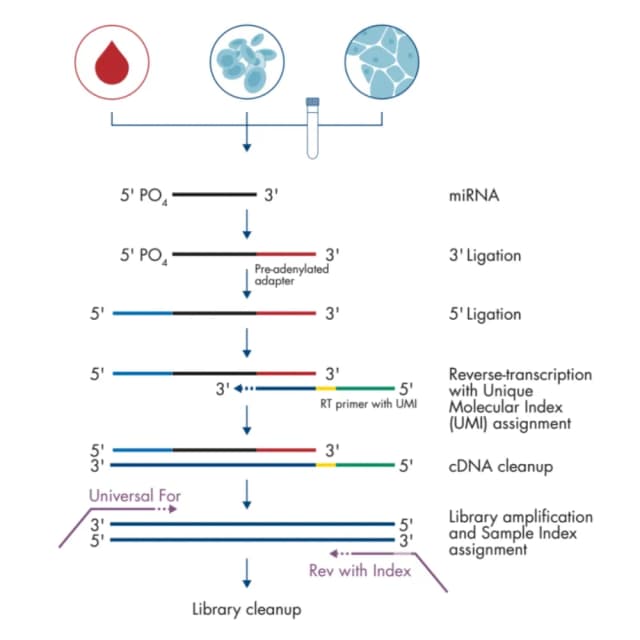
Principle Introduction
Core principle: exosome purification, small-RNA enrichment, targeted sequencing, functional analysis. Isolate exosomes and verify purity by NTA, Western blot, and TEM; extract total RNA from purified exosomes, retaining 18–25 nt miRNAs and removing genomic DNA; build a dedicated miRNA library by ligating specific adapters to both RNA ends, reverse-transcribing to cDNA, and PCR-amplifying; sequence on Illumina NovaSeq/MiSeq at ≥15 M clean reads; filter low-quality reads, align to the human reference and miRNA databases, predict targets with miRanda/TargetScan/PITA, perform GO/KEGG enrichment, and construct miRNA–mRNA/lncRNA networks.
Literature
In Circulation Research, "Angiogenic Mechanisms of Human CD34+ Stem Cell Exosomes in the Repair of Ischemic Hindlimb" showed that CD34Exo alone mimics CD34⁺ stem-cell therapy, improving perfusion, capillary density, motor function, and reducing amputation in murine ischemic hindlimb, whereas exosome-depleted conditioned medium loses this effect. CD34Exo is enriched in pro-angiogenic miRNAs, with miR-126-3p as the key component—knocking it down abolishes angiogenesis and therapeutic effect. CD34Exo directly transfers miR-126-3p to ischemic tissue (independent of host synthesis), upregulating VEGF, ANG1, and MMP9 by inhibiting SPRED1. Endothelial cells take up CD34Exo most efficiently, inducing cell-cycle entry and proliferation to promote neovascularization. By delivering pro-angiogenic miRNAs, CD34Exo mediates ischemic repair, offering a cell-free therapy direction for cardiovascular disease. The miRNA microarray sequencing used (an exosome miRNA sequencing technique) was the core tool for screening differential miRNAs, linking exosomes to parent-cell function, and locking key targets—the prerequisite for revealing miRNA-mediated angiogenesis.
Sample Requirements
serum ≥5 mL; plasma ≥5 mL; urine ≥10 mL; CSF ≥2 mL; saliva ≥3 mL.
≥20 mL.
≥200 μL.
total ≥20 ng.
Deliverables
QC report
exosome purity; RNA quality; sequencing quality.
miRNA detection and annotation
expression matrix (TPM/RPM) including known and novel miRNAs; differential analysis (volcano/heatmap with name, log2FC, P, FDR); database annotation (sequence, chromosomal location, target prediction).
Functional analysis
GO/KEGG enrichment plots (Top20), miRNA–mRNA network diagram, differential miRNA co-expression clustering.
Report
conclusions (core differential miRNA set, biomarker candidates, association strength); interpretation of regulatory mechanisms, exosome source-cell inference, clinical/research significance.
FAQ
Yes. Exosomal miRNA is typically pg–ng; ensure reliability by: ① small-RNA high-sensitivity extraction (recovery ≥70%); ② low-input miRNA library kits (min 5 ng total RNA) with optimized ligation; ③ raise depth to 20 M clean reads; ④ strict filtering to reduce false positives.
Yes—control batch effects by: ① unified sample types, isolation methods, platforms, and analysis pipelines; ② centralized RNA extraction and library construction across sites; ③ ComBat/SVA batch correction with PCA validation; ④ treat "batch" as a covariate in differential models.
