Exosomics
Harness the tiny messengers of cell-to-cell communication to advance early disease screening and dissect precise mechanisms of action.
Exosomal Whole Transcriptome Sequencing
Exosome Whole Transcriptome Sequencing (EWTS) is a high-throughput technique for all RNA molecules in extracellular vesicles (exosomes)—mRNA, lncRNA, circRNA, miRNA, etc. Exosomes are 30–150 nm membrane vesicles widely present in serum, plasma, urine, and cell-culture supernatant; their carried RNA is functionally sorted by the source cell and regulates target-cell phenotypes via intercellular communication, mirroring the source cell's pathophysiological state. Exosomal RNA is protected from RNases by the vesicle membrane (far more stable than free RNA), enriched in specific functional RNA subtypes, and obtainable non-invasively—making EWTS core for early diagnostic biomarkers, exosome-mediated communication mechanisms, and therapeutic/prognostic monitoring, especially where tissues are hard to obtain (cancer, neurodegeneration, cardiovascular disease).
Principle Introduction
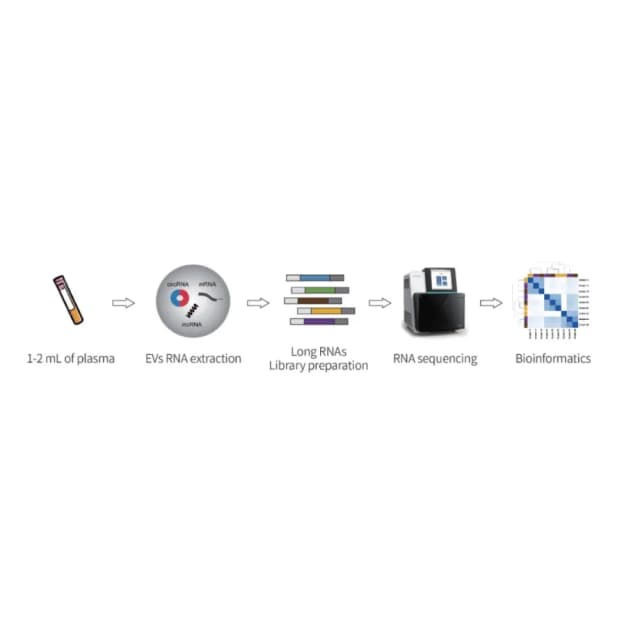
EWTS principle: exosome purification/enrichment → RNA extraction → whole-transcriptome library construction → high-throughput sequencing → functional analysis. Isolate exosomes from biofluids/supernatant (ultracentrifugation, density gradient, or kit), filter through 0.22 μm to remove debris and free RNA, and verify purity by NTA, Western blot, TEM. Extract total RNA with a high-sensitivity kit and remove genomic DNA with DNase I. Build a dual-library strategy for different RNA types. Sequence on Illumina NovaSeq/MiSeq (long-RNA ≥6 G, small-RNA ≥10 M reads) to detect low-abundance transcripts, then perform functional enrichment. By focusing on the exosomal functional RNA profile non-invasively, it captures source-cell molecular changes for disease mechanisms and clinical translation.
Literature
In Molecular Cancer, "Exosomal circ_0006896 promotes AML progression via interaction with HDAC1 and restriction of antitumor immunity" showed circ_0006896 is significantly upregulated in exosomes and cells of AML patients and correlates with poor prognosis and relapse. In vitro and in vivo, knocking down circ_0006896 inhibits AML proliferation, sensitizes to chemotherapy, and induces ferroptosis. Epigenetically, circ_0006896 binds the HDAC1 catalytic domain, enhances its interaction with histone H3, lowers H3K9/K27 acetylation, and suppresses transcription of arachidonic-acid-metabolism genes, thereby inhibiting lipid peroxidation and ferroptosis. In immune evasion, AML exosomes deliver circ_0006896 to CD8+ T cells, where HDAC1 suppresses LEF1, reducing IFN-γ and granzyme B and exhausting T cells. EWTS revealed that circ_0006896 is upregulated in AML cells and exosomes and, via HDAC1, suppresses antitumor genes (IFN-γ, GZMB), impairing CD8⁺ T cells—positioning it as a driver of chemo-resistance and immune evasion and a new therapeutic target.
Sample Requirements
serum ≥5 mL; plasma ≥5 mL; urine ≥10 mL; CSF ≥2 mL; saliva ≥3 mL.
≥20 mL.
≥200 μL.
total ≥100 ng.
Deliverables
QC report
exosome purity, RNA quality, sequencing quality.
Transcript detection and annotation
expression matrix, differential analysis, database annotation.
Functional analysis
GO/KEGG/Reactome enrichment plots, ceRNA network diagram (miRNA–lncRNA/mRNA interactions).
Analysis and interpretation report
conclusions and interpretation.
FAQ
Yes. Exosomal RNA is typically at ng levels; ensure reliability by: ① high-sensitivity extraction kits (recovery >80%); ② low-input library kits; ③ higher depth (long-RNA ≥8 G, small-RNA ≥15 M reads); ④ strict filtering to reduce false positives.
Yes—widely available, non-invasive, ideal for urinary and systemic diseases. Notes: ① collect mid-stream clean urine to avoid bacteria; ② add RNA protectant (e.g., RNAlater); ③ volume ≥10 mL to ensure exosome yield.
