Genomics
From sequence to function — exploring the essence of life at the DNA level to power breakthroughs in basic research, breeding and clinical translation.
Chloroplast Genome Sequencing
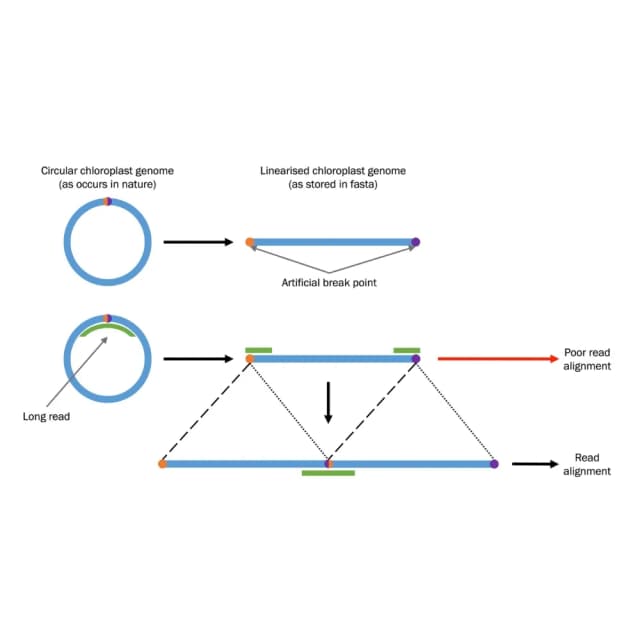
Chloroplast genome sequencing uses high-throughput sequencing to determine the complete base sequence and genome structure of chloroplast DNA in plants. The chloroplast genome is typically a circular DNA molecule with a characteristic structure of one large single-copy region (LSC), one small single-copy region (SSC) and two inverted repeats (IR) separating them, usually 120–160 kb in total. Because it is small, multicopy, structurally and sequence-conserved, maternally inherited and rarely recombines, it serves as an ideal molecular marker for species identification, phylogenetics and population genetics.
Principle Introduction
Total DNA is extracted from plant leaves and sequenced on an NGS platform such as Illumina. Bioinformatics filters chloroplast-derived reads from the whole-genome data and assembles them with dedicated software into a complete chloroplast genome sequence. Sequencing, assembly and annotation of the ~110–130 encoded genes—mainly involved in photosynthesis, gene expression and biosynthesis—inform plant phylogenetic relationships, origin and evolution, genetic diversity and germplasm identification, providing a genetic basis for crop improvement.
Literature
Published in BMC Genomics, "Comparison of different annotation tools for characterization of the complete chloroplast genome of Corylus avellana cv Tombul" focused on the complete chloroplast genome of the major cultivated hazelnut cultivar "Tombul". The study compared three annotation tools (GeSeq, cpGAVAS and DOGMA) to evaluate assembly and annotation, and their use in phylogenetics and genetic diversity. Using whole-genome shotgun data assembled via NOVOPlasty, an initial 200,017 bp contig was obtained; comparison with known genomes and Nanopore validation revealed an extra 39 kb as duplicated artifacts, fixing the genome length at 161,667 bp. Cross-validation with GeSeq, cpGAVAS and DOGMA ensured accurate gene prediction. The typical quadripartite structure (LSC, SSC and a pair of IRs) was confirmed. The study deepened understanding of hazelnut evolutionary history and provided molecular tools for agriculture and biodiversity conservation.
Sample Requirements
≥0.1 g.
≥0.5 g (≈9 cm² leaf).
≥0.2 g (remove callus, take young leaves).
total >4 μg.
Deliverables
Data QC
quality filtering of raw reads to remove low-quality, adapter and duplicate sequences, with high-quality clean data statistics.
Genome assembly
assemble clean data into a complete chloroplast genome; output circular genome file plus assembly metrics (contig number, N50, coverage).
Genome composition
coding gene annotation (protein-coding, tRNA, rRNA genes) and functional annotation via public databases.
Circular genome map
visualize the circular structure integrating genes, ncRNA and GC content.
Advanced analysis
customization, collinearity, SNP/InDel detection, IR expansion/contraction, phylogenetics, database construction and multi-omics integration.
FAQ
Moderate size (12–200 kb); conserved structure (two IRs, LSC, SSC); stable gene count (~110–130, mainly photosynthesis, transcription, translation); low mutation rate—ideal phylogenetic marker; predominantly maternal inheritance.
Phylogenetics (conserved sequences for species ID and evolution); plant taxonomy/DNA barcoding; photosynthesis and functional gene studies; evolution and domestication (wild vs. cultivated differences).
IR duplication causing breaks/misjoins; multicopy/homologous sequences affecting uniformity; nuclear/mitochondrial sequence transfer (distinguish nupDNA/mptDNA); heteroplasmy (slightly different copies within one plant) reducing accuracy.
