Genomics
From sequence to function — exploring the essence of life at the DNA level to power breakthroughs in basic research, breeding and clinical translation.
T2T Genome Sequencing
T2T (Telomere-to-Telomere) genomes combine PacBio HiFi long reads, ONT ultra-long reads, and Hi-C to assemble one or more chromosomes gap-free from telomere to telomere, resolving the missing telomeric, centromeric, and rDNA repeats of draft genomes. High-quality T2T references have been built for rice, Arabidopsis, grape, and human, greatly improving contiguity and annotation completeness and opening new perspectives for biology and breeding.
Principle Introduction
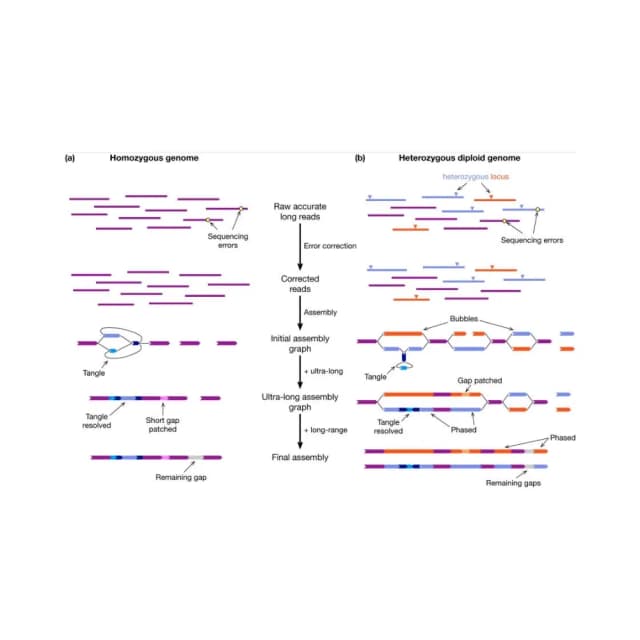
A T2T genome is assembled from multiple sequencing technologies to 0 or near-0 gaps, overcoming centromere and repeat assembly difficulty and greatly improving continuity and integrity. The strategy combines PacBio HiFi and Nanopore Ultra-long: HiFi offers high-accuracy reads (N50 ~15 Kb, Q30 ≥75%) for faithful assembly; Nanopore Ultra-long reaches Mb scale, spanning repeats. The two assemblies are merged, error-corrected, and anchored to chromosomes with Hi-C to complete a high-quality T2T genome.
Experiment Flow
Sample QC
check sample quality and purity to ensure suitability for T2T sequencing.
DNA extraction
extract high-purity, high-integrity genomic DNA suitable for long reads.
Library construction
build PacBio HiFi and ONT Ultra-long libraries for complementary reads.
Sequencing and QC
sequence on PacBio Revio HiFi and Nanopore Ultra-long with fastplong QC.
Assembly
hifiasm/NextDenovo assembly, Hi-C anchoring, gap and telomere completion.
Assessment
assess genome size, contiguity N50, BUSCO completeness, consistency, QV.
Annotation
annotate repeats, ncRNA and gene structures with GO/KEGG/InterPro.
Sample Requirements
animal tissue/cells, blood, plant, insect, marine mollusk, etc.
animal tissue 3×10^6 cells, cells 3×10^6, blood 2 mL, plant 2 g, insect 1 g; per-library use 1×10^6 cells, 1×10^6 cells, 1 mL, 300 mg, 100 mg.
for de novo assembly, take all libraries from one individual (PacBio, Illumina, ONT, Hi-C) at the same tissue; if insufficient, pool from closely related individuals, minimizing mixed counts.
EDTA only (no other anticoagulant), 4℃ and ship within 3 days; else snap-freeze 30 min, -80℃, dry ice.
≥2.0×10^6, viability >75%, freeze in 20% FBS+10% DMSO, -80℃/liquid N2, dry ice.
prefer high-cellularity low-fat tissue, snap-freeze 30 min, -80℃, dry ice.
young living tissue, rinse ≥3×, dry, freeze, -80℃, dry ice.
embryo>new larva>early pupa>adult; starve days before freezing, -80℃, dry ice.
next-day courier, ample dry ice, complete sample info sheet.
Deliverables
Assembly
T2T FASTA, gap/telomere repair, Hi-C chromosome mapping.
Assembly assessment
size, Contig/Scaffold N50, BUSCO, short-read consistency, QV tables/plots.
Repeat annotation
RepeatMasker classification (LTR/TIR/LINE/SINE) tables/maps.
ncRNA annotation
miRNA/tRNA/rRNA/snRNA/snoRNA sequences and positions (Infernal/Rfam).
Gene set
GFF3 after homology+ab initio+EVM+PASA.
Functional annotation
GO, KEGG, InterPro, SwissProt, NR.
Final report
full PDF with methods, figures, interpretation.
FAQ
Four dimensions: contiguity (N50), completeness (BUSCO), consistency (short-read mapping), and QV; higher QV means fewer errors.
