Genomics
From sequence to function — exploring the essence of life at the DNA level to power breakthroughs in basic research, breeding and clinical translation.
Whole-Genome Sequencing (WGS)
Human whole-genome sequencing (WGS) resequences individuals or populations against the human reference to identify genome-wide genetic variation at individual or population level—enabling genotypic diversity, evolutionary, pathogenic/susceptibility gene, monogenic disease and cancer screening. With the spread of NGS (Illumina), WGS has become one of the fastest, most effective tools in human genetics, translational medicine and population evolution, comprehensively uncovering sequence differences and structural variation (SNV, SNP, InDel, CNV, SV) and scanning for phenotype-, disease- and evolution-related mutations genome-wide.
Principle Introduction
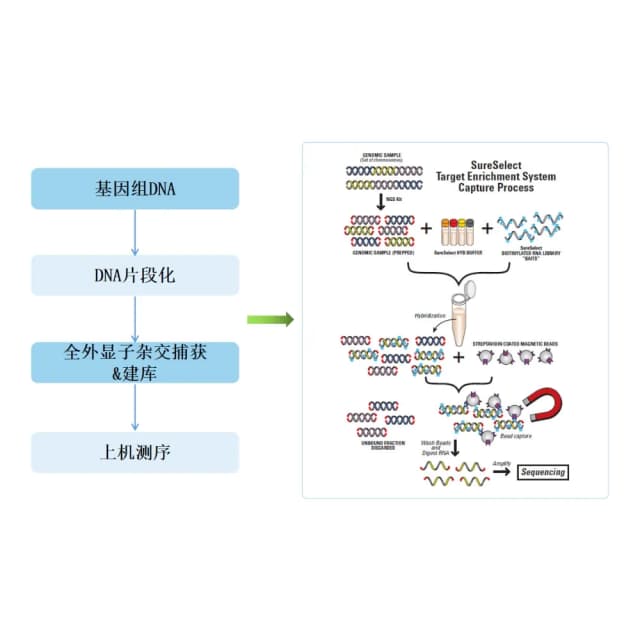
Library construction: random DNA shearing, adapter ligation, amplification. Sequencing: Sequencing-by-Synthesis generates short reads (e.g., 150 bp on Illumina). Alignment: reads aligned to a reference (e.g., GRCh38) to identify variants. Variant detection: SNP, InDel, SV/CNV called via GATK, Samtools, etc. Annotation: variants annotated with functional databases (ClinVar, dbSNP) to interpret biological meaning.
Literature
On April 23, 2025, authors from the University of Washington published in Nature "Human de novo mutation rates from a four-generation pedigree reference," using WGS data from a four-generation pedigree (CEPH 1463) to build the first comprehensive map of human de novo mutations (DNM). Across 28 individuals in four generations, five complementary technologies (PacBio HiFi, ultra-long ONT, Strand-seq, Illumina, Element AVITI) with long-read sequencing (LRS) achieved >95% high-quality phasing and assembly (including 288 centromeres, 6 Y chromosomes), building the first telomere-to-telomere (T2T) family genome resource. WGS broke technical limits to assemble repeat-rich "genomic dark matter" (e.g., centromeres, tandem repeats) via long reads (PacBio HiFi 15–20 kb); its high depth (avg >30×) and contiguity accurately detected SNV, InDel and SV, especially paternal germline-origin DNM (75–81%); and it built a 3.4 kb-resolution recombination map, showing tandem repeats (TR) as the most mutable regions (32 recurrent sites), with mutation rate linked to repeat-unit size and motif length.
Experiment Flow
DNA fragmentation
shear genomic DNA by sonication into uniform fragments for library prep.
Pre-library prep
repair fragment ends and add 3′ A-tails for adapter ligation.
Adapter ligation
ligate sequencing adapters to build the initial fragment library.
Hybridization capture
hybridize liquid-phase probes to capture target genomic regions.
Target enrichment
recover captured target regions by magnetic bead purification.
PCR amplification
amplify enriched DNA by PCR to build the final sequencing library.
Library QC
validate the finished library by qPCR and Bioanalyzer for size and yield.
Sequencing
qualified libraries are pooled and sequenced on an Illumina platform.
Sequencing parameters
paired-end PE150 mode with a total read length of 300 bp per fragment.
Sample Requirements
DNA, blood, tissue, cell lines, FFPE, etc.
Genomic DNA.
total DNA ≥0.2 μg (recommend 0.4 μg).
total DNA ≥1 μg (recommend 2 μg).
total DNA ≥50 ng.
≥5×10^6 cells.
≥50 mg.
≥0.6 mL.
≥10 unstained sections, 100 mm², 5–10 μm.
Deliverables
Alignment
BAM/SAM files with coverage and alignment rate statistics.
Variant detection
SNP/InDel/VCF files with allele frequency, quality and filtering.
Functional annotation
ANNOVAR results linked to GO/KEGG pathways.
Visualization
chromosome coverage, Manhattan and heatmap plots.
Report
experimental design, QC parameters, variant summary and biological interpretation.
FAQ
IGV is a high-performance genome browser that merges different data types and flexibly zooms into regions.
Use the "human genome variation interactive analysis system" for filtering; focus on nonsynonymous, splice and frameshift mutations from annotations.
Typically patient + unaffected parents (3) or a 3+ generation pedigree (about a dozen).
Typically cases + healthy controls (hundreds to thousands) or large 3+ generation pedigrees.
