Single-Cell Omics
Resolve tissue heterogeneity at single-cell resolution to precisely define cell subpopulations and their differentiation trajectories.
10x scRNA-Seq
10x single-cell transcriptomics is a microfluidics- and high-throughput-sequencing-based technology for mRNA expression profiling at single-cell resolution, capturing thousands to tens of thousands of cells to resolve cell subpopulations, heterogeneity, and regulatory networks. Unlike bulk RNA-seq, it overcomes population averaging to capture rare cell types, dynamic states, and functional differences. It is a core tool in biomedicine, oncology, neuroscience, and developmental biology—applied in tumor microenvironment, differentiation trajectories, rare-cell identification, disease mechanisms, and drug-target screening.
Principle Introduction
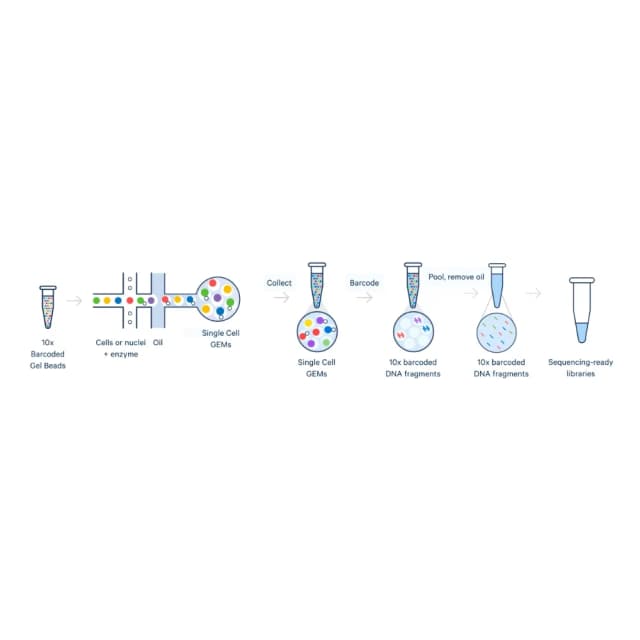
Based on 'microfluidic capture–single-cell barcoding–reverse transcription–sequencing': single cells, gel beads carrying cell and molecular barcodes, and RT reagents are encapsulated in oil droplets (one cell + one bead per droplet). Bead-derived barcodes label each cDNA during RT, enabling assignment of reads to individual cells via cell barcode and absolute quantification via molecular barcode, yielding per-cell expression profiles for clustering, heterogeneity, and network analysis.
Literature
Published in Frontiers, 'Single-cell transcriptomics reveals tumor microenvironment remodeling in hepatocellular carcinoma with varying tumor subclonal complexity' used 10x single-cell transcriptomics to map TME remodeling across HCC subclonal complexity. Tens of thousands of cells from tumor and adjacent tissue revealed immune-suppressive cell enrichment (Treg, M2 macrophage) and stromal activation in high-complexity HCC, forming a pro-tumor microenvironment.
Sample Requirements
≥0.1 g/sample, in preservation buffer, 4°C refrigerated shipping (no freezing), arrive within 24 h; note type, site, patient info.
1×10⁵–1×10⁶ cells/mL, ≥1 mL, serum-free medium + 0.04% BSA, 4°C; viability ≥85%, no clumps/RBC.
≥2 mL, EDTA, 4°C, arrive within 6 h; note time, PBMC separation.
≥1×10⁶ cells, single-cell suspension, 4°C; note line, culture, treatment.
pellet ≥5×10⁶, cryopreserved, dry ice; thaw and make suspension immediately.
Deliverables
Raw data
Fastq reads, QC report (Q30, GC, adapter), barcode statistics.
Analysis report
cell filtering/clustering, subpopulation annotation, differential expression (volcano/heatmap), trajectory, enrichment, conclusions.
Technical docs
suspension protocol, library/sequencing parameters, analysis code, visualization guide.
FAQ
Optimize suspension, filter clumps, lower concentration, computational doublet removal.
Increase capture, gentle handling, FACS pre‑enrichment, high‑efficiency platform.
Use known markers (CD4, CD8A, EPCAM), public atlases, tune resolution, integrate multi‑omics.
