Single-Cell Omics
Resolve tissue heterogeneity at single-cell resolution to precisely define cell subpopulations and their differentiation trajectories.
10x Single-Cell VDJ Sequencing
10x single-cell VDJ sequencing is an immunomics technology on the 10x Genomics microfluidics and high-throughput sequencing platform that profiles T-cell receptor (TCR) and B-cell receptor (BCR) diversity at single-cell resolution, simultaneously capturing receptor sequences, expression, and phenotype to resolve clonotype composition, expansion, and functional status. Unlike bulk VDJ, it links each receptor sequence to its cell subpopulation, tracking rare clones and clonal expansion to reveal immune-response mechanisms—applied in CAR-T efficacy, infectious disease, autoimmunity, and vaccine research.
Principle Introduction
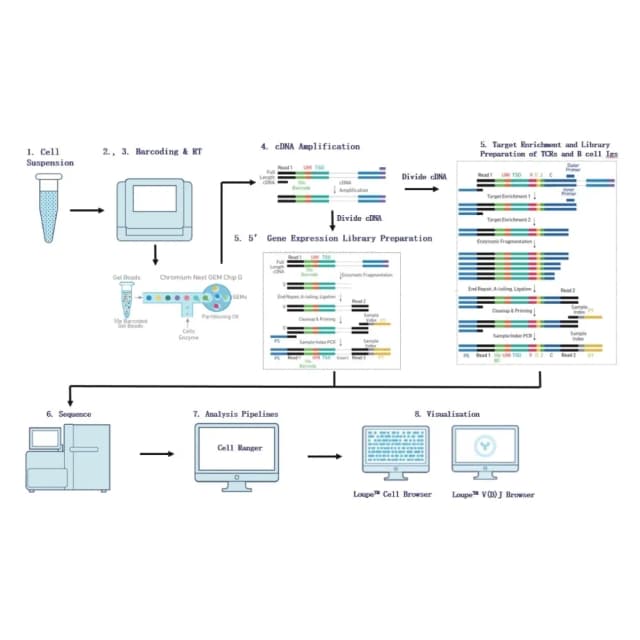
Based on 'single-cell capture–receptor-specific amplification–sequencing': T/B cells, barcode beads, and reagents are encapsulated; V(D)J regions of TCR and BCR (IGH, IGK/IGL) are amplified with specific primers while cell/molecular barcodes label each receptor transcript. Sequencing data are assigned per cell via cell barcode; assembly yields full VDJ rearrangements, clonotypes, and expression, linkable to transcriptomes.
Literature
Published in Nature Cancer, 'Temporal single-cell tracing reveals clonal revival and expansion of precursor exhausted T cells during anti-PD-1 therapy in lung cancer' used 10x single-cell VDJ to reveal clonal dynamics of precursor exhausted T cells (Tpex) during anti-PD-1 therapy. Longitudinal tumor and blood samples showed Tpex clones revived and expanded in responders, highly expressing TCF-1; these differentiated into effector T cells and correlated with efficacy, providing a molecular basis for monitoring.
Sample Requirements
1×10⁵–1×10⁶ cells/mL, ≥1 mL, serum-free + 0.04% BSA, 4°C; viability ≥85%, FACS-enriched preferred.
≥0.1 g, preservation buffer, 4°C (no freezing), 24 h; note type/site.
≥2 mL, EDTA/heparin, 4°C, 6 h; note PBMC separation.
pellet ≥5×10⁶, immune-cell freezing medium, liquid N2, dry ice; thaw promptly.
≥1×10⁶ cells, 4°C; note culture, transfection, stimulation; viability ≥90%.
Deliverables
Raw data
Fastq, QC (Q30, adapter), barcode stats, VDJ amplification.
Analysis
TCR/BCR clonotype annotation, diversity, expansion heatmap, V/J usage, receptor sequence and phenotype association.
FAQ
Causes: Poor RNA, fragment loss, algorithm. Optimize storage, cycles, assembly params, public VDJ DB.
Same 10x platform dual assay shares cell barcode; integrate clonotype with expression.
