Single-Cell Omics
Resolve tissue heterogeneity at single-cell resolution to precisely define cell subpopulations and their differentiation trajectories.
DNBELAB scRNA-Seq
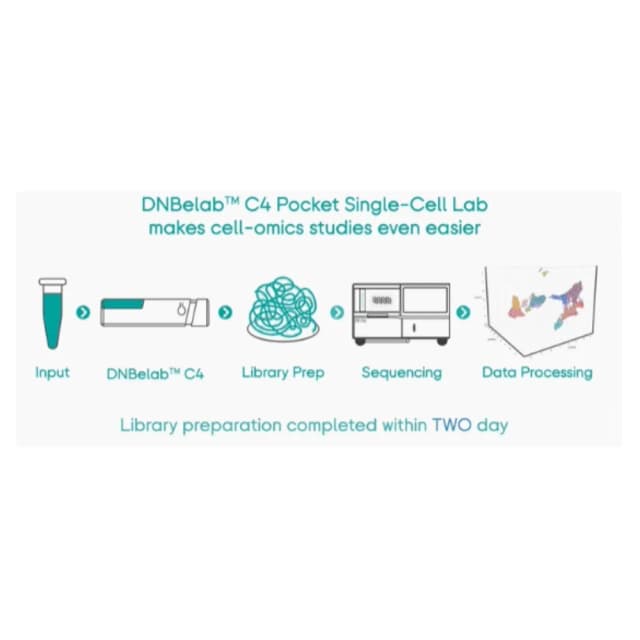
DNBelab single-cell transcriptomics is a high-throughput platform independently developed by BGI, built on the DNBelab C4 library system and DNBSEQ sequencing, capturing mRNA profiles at single-cell resolution to resolve subpopulations, regulatory networks, and heterogeneity—from hundreds to millions of cells. As a domestic benchmark, it breaks import-platform monopolies with high throughput, low cost, and multi-modal compatibility; unlike bulk RNA-seq and some imported platforms, it unbiasedly captures rare subpopulations, integrates morphology and protein data, and adapts to limited samples. Applied in cell atlasing, TME, development, neuroscience, and crop breeding.
Principle Introduction
Based on 'high-density DNA nanoball (DNB) array–single-cell in-situ capture–dedicated barcoding' without oil-droplet encapsulation: a high-density DNB array (220 nm DNBs at 500 nm pitch) electrostatically captures single cells in situ, avoiding loss/deformation. After capture, primers bind mRNA poly(A) tails, RT generates cDNA with cell and molecular barcodes. Amplified cDNA builds DNB libraries for DNBSEQ; barcodes assign reads to cells, yielding expression profiles, clustering, and multi-dimensional cell maps.
Literature
Published in Science, 'Cross-species single-cell spatial transcriptomic atlases of the cerebellar cortex' used DNBelab C4 with Stereo-seq to build cross-species cerebellar atlases, revealing primate-specific Purkinje cell subtypes (both high in GRID2, one enriched for learning-related pathways absent in mice), providing high-quality resources for brain research.
Sample Requirements
1×10⁵–5×10⁶ cells/mL, ≥1 mL, serum-free + 0.04% BSA, 4°C; viability ≥85%, no freeze-thaw.
≥0.1 g, dedicated buffer, 4°C (no freezing), 24 h.
≥1×10⁶ cells / ≥0.05 g organoid; 4°C.
≥2 mL, EDTA/heparin, 4°C, 6 h; PBMC fresh, viability ≥90%.
≥0.5 g, snap-frozen -80°C, dry ice; note variety, part, stage.
Deliverables
Raw data
Fastq, barcode stats, QC, DNB library params.
Analysis
filtering/clustering, subpopulation annotation, differential volcano/heatmap, enrichment, trajectory.
Technical docs
suspension protocol, parameters, analysis code, visualization; supports Stereo-seq/protein integration.
FAQ
Use enzymatic + mechanical dissociation to protoplasts, optimize lysis, custom parameters.
Same‑platform compatibility maps subpopulations to spatial dimensions.
Use serum‑free gradient freezing, rapid thaw, process within 2 h; prefer fresh, ≤3 months.
