
Transcriptomics
Capture gene-expression dynamics with precision and reveal regulatory mechanisms — reconstructing gene-response patterns under any experimental condition.
Circular RNA (circRNA) Sequencing
Circular RNAs (circRNAs) are covalently closed non-coding RNAs lacking a 5′ cap and 3′ poly(A) tail. First found in viruses in the 1970s, they were long regarded as splicing byproducts. High-throughput sequencing later revealed their widespread presence in eukaryotes with tissue- and developmental-stage-specific expression. circRNAs mainly form via back-splicing, where a downstream splice donor joins an upstream splice acceptor to close a loop. Their stable structure (RNase R-resistant) and strong conservation enable roles in gene regulation, miRNA sponging, protein interaction, and translation, and they are closely linked to cancer, neurodegeneration, and cardiovascular disease.
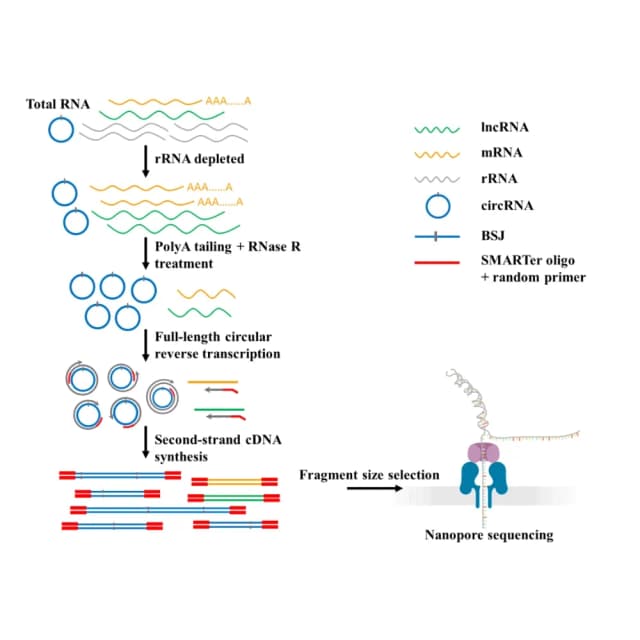
Principle Introduction
circRNA research centers on its back-splicing property and circular structure. Unlike canonical linear splicing (exons joined in genomic order), circRNAs are formed by covalent joining of a downstream 5′ splice site to an upstream 3′ splice site, producing a circular molecule.
Literature
Published in Nature Communications, Zheng et al. reported 'Circular RNA profiling reveals an abundant circHIPK3 that regulates cell growth by sponging multiple miRNAs,' a landmark study that established circHIPK3 as a canonical functional circular RNA. circHIPK3 arises from back-splicing of exon 2 of the HIPK3 gene and is broadly expressed across human tissues. Acting as a miRNA sponge (ceRNA), circHIPK3 sequesters miR-124, miR-29, and miR-379, thereby de-repressing downstream targets such as IL6R, DLGAP1, and BCL2 to regulate cell proliferation, apoptosis, and angiogenesis. It is upregulated in bladder, liver, lung, and colorectal cancers, where it drives tumor progression. As a classic example of circRNA-mediated ceRNA regulation, circHIPK3 anchors circular RNAs within gene regulatory networks and paved the way for non-coding RNA research.
Sample Requirements
≥5 × 10⁶. Lyse thoroughly with sufficient TRIzol or a dedicated protectant and store at −80°C, or make a cell pellet and snap-freeze. Ensure viability >95% and completely remove medium. Avoid reagents that affect RNA extraction (e.g., heparin).
≥50 mg. Rinse briefly with cold PBS, cut into ≤50 mg pieces, snap-freeze in liquid nitrogen, store at −80°C. Nuclease-rich organs (heart, liver, spleen) need faster handling. Avoid freeze-thaw cycles.
≥100 mg. Use fresh young tissue, snap-freeze in liquid nitrogen, grind to powder, store at −80°C. For high polyphenol/polysaccharide species, consult a special protocol.
≥4 mL. Collect in EDTA or sodium citrate tubes, hold at 4°C, isolate leukocytes or extract total RNA within 6 h. Never use heparin tubes—they severely inhibit downstream enzymatic reactions.
≥2 mL. Centrifuge at 3000g for 10 min within 2 h of collection, aliquot, store at −80°C. Avoid hemolysis, which releases background RNA.
5–10 sections (5–10 μm). Provide unstained serial sections in RNase-free tubes/slides. Also provide matched H&E sections for pathology assessment and note the section date.
Deliverables
Sample quality and correlation
inter-sample correlation heatmap based on circRNA expression, PCA plot showing group differences and intra-group reproducibility; global circRNA identification/annotation and alternative circularization analysis.
Advanced module
differential circRNA analysis with a list (expression, fold change, P, FDR), volcano and clustering heatmaps.
Host gene function and pathway enrichment
GO, KEGG, and Reactome enrichment.
ceRNA network prediction
target miRNA prediction, circRNA–miRNA–mRNA network construction, extended functional prediction.
Custom module
fusion-gene-derived circular RNA (f-circRNA) analysis.
FAQ
Gold standard: ① divergent primers spanning the back-splice junction for qRT-PCR; ② Sanger sequencing of the junction; ③ Northern blot showing a migration shift versus linear RNA and RNase R resistance.
Commonly, prefix "circ-" to the host gene name—e.g., circHIPK3 from the HIPK3 gene. Multiple circRNAs from one gene are distinguished by publication order or circularized exon number (e.g., circHIPK3_2, circHIPK3_exon2).
