
Transcriptomics
Capture gene-expression dynamics with precision and reveal regulatory mechanisms — reconstructing gene-response patterns under any experimental condition.
Whole Transcriptome RNA-Seq
Whole Transcriptome Sequencing is a high-throughput, unbiased technique that comprehensively analyzes all RNA molecules in a cell (including mRNA and non-coding RNA). It quantifies gene expression and detects complex transcriptome features such as alternative splicing, novel transcripts, fusion genes, allele-specific expression, and RNA editing. Traditional expression studies relied on microarrays, limited by known probe design and unable to discover novel transcripts or non-coding RNAs. With NGS, RNA-Seq emerged around 2008 and became the mainstream transcriptome method.
Principle Introduction
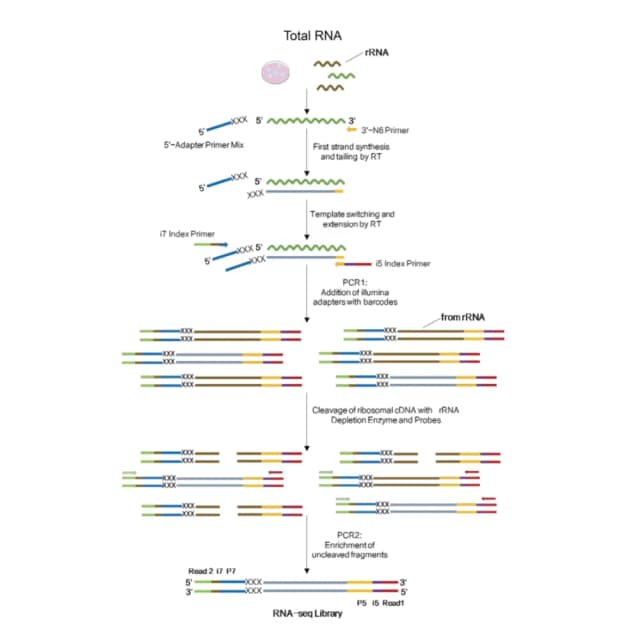
Whole Transcriptome Sequencing extracts total RNA from cells or tissues, constructs cDNA libraries, deeply sequences the cDNA on a high-throughput platform (e.g., Illumina), and reconstructs the transcriptome map via bioinformatics. Sample prep and QC: extract high-quality total RNA (RIN ≥ 7.0, normal 28S/18S ratio) and assess with Agilent 2100. rRNA depletion: use a commercial kit (e.g., Ribo-Zero) to efficiently remove rRNA. Library construction: long-RNA library—fragment rRNA-depleted RNA, reverse-transcribe with random hexamers, synthesize double-stranded cDNA, end-repair, A-tail, ligate adapters, and PCR-amplify; small-RNA library—isolate 18–30 nt small RNAs, ligate 3′/5′ adapters, reverse-transcribe, and PCR-amplify. QC and quantitation: Qubit for accurate concentration, Agilent 2100 for fragment-size distribution. Sequencing: pool libraries and perform paired-end sequencing on Illumina NovaSeq/HiSeq. Recommended depth: ≥12 Gb/sample for long RNA, ≥10 M reads/sample for small RNA.
Literature
In Nature, "lincRNAs act in the circuitry controlling pluripotency and differentiation." systematically dissected lincRNA function in mouse embryonic stem cells (ESC) at the whole-transcriptome scale. shRNA knockdown of 226 ESC-high lincRNAs coupled with expression profiling showed 93% significantly altered hundreds of protein-coding genes, with impact comparable to classic pluripotency factors Oct4 and Nanog. Functionally, 26 lincRNAs were essential for pluripotency—their knockdown reduced Nanog/Oct4 and lost ESC morphology; 30 others actively repressed lineage (endoderm/mesoderm) differentiation in the undifferentiated state. Mechanistically, their promoters are bound by pluripotency TFs, and ~30% physically interact with chromatin regulators PRC2, Jarid1b, HDAC1 in trans. The work established lincRNAs as indispensable regulatory components, not transcriptional "noise".
Deliverables
Standard informatics results
alignment statistics and expression quantification matrix (all RNA types), RNA identification and characterization, differential expression analysis, GO/KEGG enrichment of differential mRNAs.
Advanced customized analysis
key small-RNA target analysis—target prediction and GO/KEGG enrichment for client-specified sncRNAs; ceRNA regulatory network—integrating differential miRNA, lncRNA, circRNA, and mRNA into a core network.
Biomarker model analysis
predictive models for disease diagnosis or prognosis based on multi-sample expression profiles (consult for details).
Other analyses
alternative splicing, gene fusion detection, etc.
FAQ
Whole-transcriptome must use rRNA depletion. PolyA enrichment loses most lncRNAs, circRNAs, and non-polyA mRNAs, failing the "whole" transcriptome goal.
Capture efficiency differs by RNA type due to fragment length and structure. Standard pipelines process them separately, but absolute quantification needs caution; comparing relative changes of the same RNA type across samples is generally more reliable.
