
Transcriptomics
Capture gene-expression dynamics with precision and reveal regulatory mechanisms — reconstructing gene-response patterns under any experimental condition.
SMART-Seq2
Smart-seq (Switching Mechanism at 5′ end of RNA Template) is a full-length single-cell RNA sequencing technique whose key advantage is capturing complete mRNA sequences, overcoming the short reads and incomplete 5′ coverage of platforms like 10x Genomics. Via a unique reverse-transcription primer design, it efficiently reverse-transcribes and amplifies full-length cDNA from a single cell, preserving 5′/3′ ends and alternative splicing for high-resolution quantification, splicing analysis, and novel transcript discovery. SMART-seq2 (2013) improved efficiency and coverage, with more precise primers that better handle low-quality RNA and capture expression more sensitively.
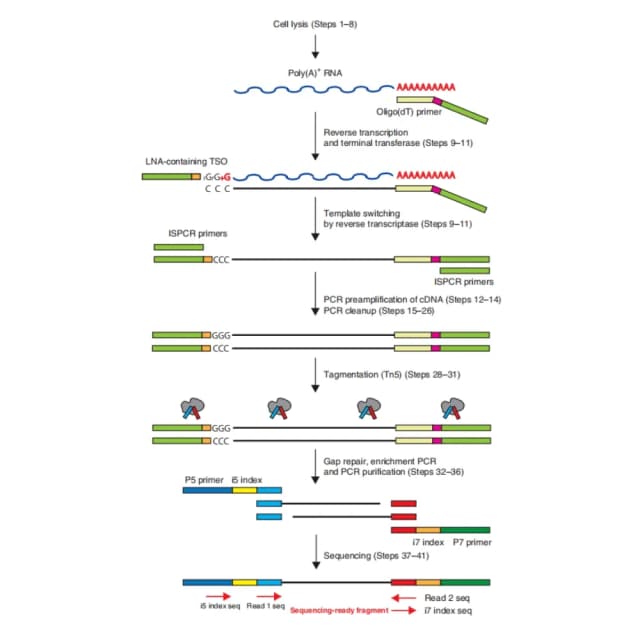
Principle Introduction
SMART-Seq2 exploits the template-switching activity of reverse transcriptase with an optimized reaction to synthesize and uniformly amplify full-length single-cell cDNA: lyse the cell to release mRNA; the poly(A) tail binds an oligo(dT) primer to initiate RT; upon reaching the 5′ end, the enzyme's template-switching activity recognizes and binds a locked nucleic acid (LNA)-modified template-switch oligo (TSO), extending from TSO to form first-strand cDNA containing the full mRNA, with LNA enhancing TSO binding stability and 5′ capture; high-fidelity PCR with optimized primer concentration/cycles reduces amplification bias; the amplified cDNA is fragmented and adapter-ligated into a library for full-length transcriptome sequencing and downstream multidimensional analysis.
Literature
In Genome Biology, "ZAR1 and ZAR2 orchestrate the dynamics of maternal mRNA polyadenylation during mouse oocyte development." carefully analyzed Smart-seq2's technical properties to resolve a long-standing controversy over ZAR1, a maternal mRNA regulator in oocytes. Two prior Smart-seq2 studies reached contradictory conclusions. The Fan Hengyu team realized the discrepancy might stem from the technique itself: Smart-seq2 relies on Oligo-dT to capture polyA-tailed mRNA, but during late oocyte maturation the polyA tail shortens markedly, lowering capture efficiency and biasing abundance estimates. They designed a key experiment comparing Smart-seq2 with a polyA-independent Total RNA-seq on the same-stage oocytes, confirming that Smart-seq2 overestimated mRNA downregulation because the average polyA tail shrank to ~8 nt, reducing capture. This showed the observed dynamics mainly reflect polyA-tail-length changes rather than massive degradation, reinterpreting the data to establish ZAR1's true role as dynamically regulating polyA state rather than simply promoting degradation or stability.
Sample Requirements
>1×10³ / sample; wash with PBS, centrifuge, resuspend in 10% DMSO freezing medium, store at −80°C, ship on dry ice; viability >85%.
>2×10³ / sample; trypsinize, centrifuge, wash PBS twice, freeze as above; provide cell line name and culture conditions.
>5×10³ / sample; enzymatic dissociation, filter debris, viability >80%, store at −80°C, ship on dry ice; note tissue type.
isolated single cells in RNase-inhibitor lysis buffer, ship with ice pack, arrive within 24 h.
Deliverables
Library QC report
fragment-size electrophoresis, concentration, integrity (RIN).
Raw sequencing data
FASTQ with QC report (Q30 ≥85%).
Complete experimental report
principles, instruments/reagents, detailed steps (cell separation, RT, amplification, library conditions), QC records.
Bioinformatics report
preprocessing, expression matrix, differential gene list, alternative splicing, cell clustering, GO/KEGG enrichment, key-gene validation suggestions.
FAQ
① too little single-cell mRNA—use viable cells, avoid apoptosis; ② low RT efficiency—use high-quality RT enzyme, optimize TSO/primer ratio; ③ insufficient PCR cycles—increase (max 28) but avoid over-amplification bias; ④ bead purification loss—adjust bead:sample ratio and purification.
① extend 42°C incubation to 120 min to improve RT extension; ② use modified TSO (e.g., LNA) to boost template switching and 5′ capture; ③ minimize RNA degradation—keep on ice, add RNase inhibitors, avoid freeze-thaw.
① standardize workflow timing/conditions for consistency; ② add ≥3 independent biological replicates per group; ③ correct via housekeeping genes (GAPDH, ACTB) or batch-effect algorithms (e.g., ComBat).
