Transcriptomics
Capture gene-expression dynamics with precision and reveal regulatory mechanisms — reconstructing gene-response patterns under any experimental condition.
De Novo Transcriptome Sequencing
Eukaryotic De Novo Transcriptome (EDNT) targets eukaryotes lacking a complete or high-quality reference genome (e.g., fragmented assembly, missing annotation), using high-throughput sequencing to systematically sequence, de novo assemble, quantify, and functionally annotate mRNA (and non-coding RNA). Its core advantage is independence from a known genome—transcript sequences specific to the species are assembled directly from reads, enabling expression quantification and functional mining. Versus reference-based transcriptomes, EDNT offers three core values: ① no species limit—rare, newly discovered, or unsequenced species (e.g., endemic medicinal plants, rare animals); ② novel transcript discovery—species-specific transcripts, new genes, alternative splicing isoforms; ③ self-built reference—the assembled transcriptome serves as a "temporary reference" for downstream studies and a basis for genome sequencing/annotation.
Principle Introduction
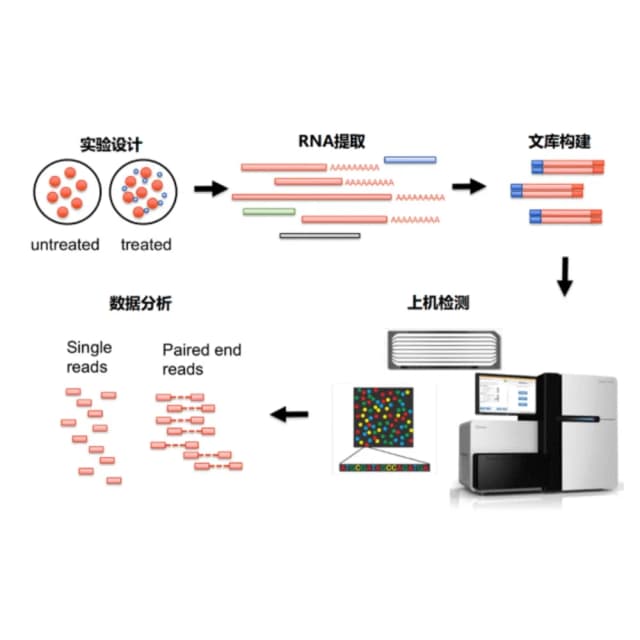
Core principle of EDNT: sample handling and RNA extraction via a "high-integrity RNA enrichment strategy"—① disruption; ② extraction; ③ QC. Strand-specific library construction—① fragmentation; ② reverse transcription; ③ adapter ligation; ④ UDG digestion; ⑤ PCR amplification to enrich library fragments (improves assembly accuracy, especially for ncRNA annotation). High-throughput sequencing on Illumina, optionally with PacBio long reads for complex species. Data analysis and interpretation—① filtering; ② de novo assembly; ③ quantification; ④ functional annotation; ⑤ advanced analysis.
Literature
In PNAS, "How to upgrade stolen organelles into permanent plastids: A comparative transcriptomic perspective" focused on secondary endosymbiosis in two diatoms (D. kwazulunatalensis and D. smirnovii), both lacking a complete reference genome. Using de novo transcriptome sequencing and comparative analysis, the team identified differentially expressed genes related to plastid integration, finding that D. kwazulunatalensis underwent pronounced nuclear genome remodeling and expressed a complete hexose-phosphate export pathway, indicating deeper metabolic integration with the plastid and offering new insight into eukaryotic secondary endosymbiosis. De novo assembly overcame the lack of a reference, enabling systematic analysis of expression changes during secondary endosymbiosis and revealing the molecular mechanism by which plastids convert from stolen organelles into permanent ones.
Sample Requirements
animal ≥50 mg; plant ≥200 mg; FFPE ≥20 sections (5–10 μm) with total RNA ≥5 μg.
adherent ≥2×10⁶; suspension ≥3×10⁶; cell slides ≥8.
serum/plasma ≥8 mL; CSF ≥3 mL, urine ≥15 mL; saliva ≥5 mL.
total ≥2 μg.
Deliverables
QC report
RNA quality; sequencing quality; assembly quality.
Unigene assembly and annotation
assembly results; expression matrix; differential analysis; database annotation, pathway assignment, sequence homology.
Advanced analysis
novel gene prediction (species-specific sequences and annotation); SSR marker development; alternative splicing (event types, differential unigene list); transcription factor prediction (family classification, target association).
Analysis and interpretation report
conclusions (core differential unigenes, key pathways, candidate genes/SSR markers); interpretation (biological function, association with traits/treatments, application value of assembled transcripts).
FAQ
① N50—the unigene length at which cumulative length reaches 50% of the total, reflecting contiguity; ≥1000 bp acceptable, ≥1500 bp superior for complex species. ② BUSCO—match of assembled transcripts to conserved genes of related species, reflecting completeness; ≥70% acceptable, ≥85% superior (plants ≥75%, animals ≥80%). ③ Redundancy—repeat fraction ≤15% acceptable (after CD-HIT). ④ Annotation rate—≥60% acceptable, ≥75% superior.
Yes, significantly: they inhibit RNA extraction, causing degradation and low purity (OD260/230 <1.5) and dropping N50 by >30%. Remedies: a) snap-freeze in liquid nitrogen immediately; b) add PVP and β-mercaptoethanol with CTAB to remove polysaccharides/polyphenols; c) use plant-specific RNA kits; d) if purity fails, ethanol precipitation + LiCl purification.
Via "technical optimization + experimental validation": a) strand-specific libraries and RSEM for accuracy; b) more biological replicates and statistical testing to reduce false positives; c) qPCR validation of core unigenes; d) homology alignment to a relative's reference transcriptome to calibrate.
They serve as a "temporary reference transcriptome" but cannot fully replace a genome: useful for gene cloning, quantification, and SSR development, but unigenes are transcript sequences lacking chromosomal location, full intron information, and non-transcribed regions.
