
Transcriptomics
Capture gene-expression dynamics with precision and reveal regulatory mechanisms — reconstructing gene-response patterns under any experimental condition.
lncRNA Sequencing
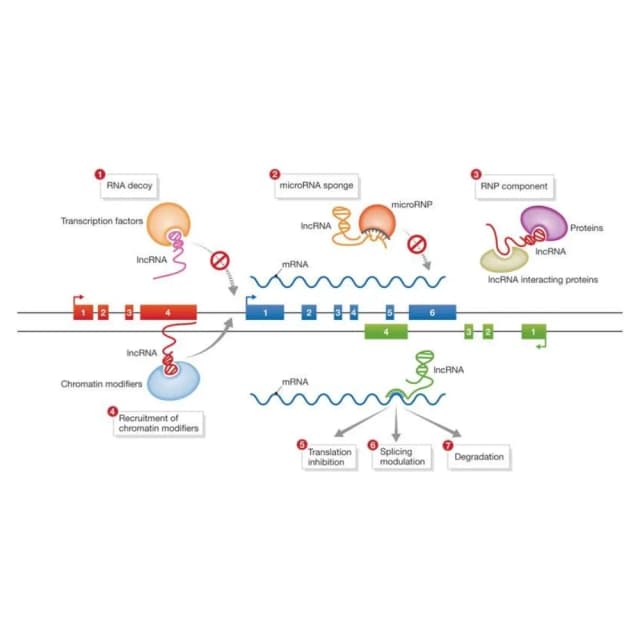
Long noncoding RNAs (lncRNAs) are non-coding RNAs longer than 200 nt that regulate gene expression at epigenetic, transcriptional, and post-transcriptional levels by binding DNA, RNA, or proteins. lncRNA sequencing accurately identifies lncRNAs and predicts their target genes in samples with a reference genome, and also analyzes mRNAs from the same data, giving a more comprehensive picture. It is widely used in medicine and agriculture.
Principle Introduction
High-throughput sequencing plus bioinformatics rapidly and accurately discovers functionally important lncRNAs, explores their relationships with biological processes, and decodes their regulatory mechanisms, including the ceRNA mechanism competing for miRNA binding and regulation of chromatin structure (enhancers, promoters, insulators). Total RNA is obtained and rRNA-depleted; cDNA is synthesized (strand-specific library) by fragmenting RNA to 250–300 bp with fragmentation buffer and reverse-transcribing with random hexamers; second-strand cDNA is synthesized with buffer, dNTPs, and DNA polymerase I, then purified with AMPure XP beads; after end-repair and adapter ligation, the double-stranded cDNA is A-tailed and adaptor-ligated, size-selected with AMPure XP beads, and the U-containing second strand is degraded with USER enzyme followed by another size selection.
Literature
In Molecular Cancer, "Integrative Multi-Omics Analysis Reveals the lncRNA 60967.1–PLCD4–ATRA Axis as a Key Regulator of Colorectal Cancer Progression and Immune Response" used multi-omics (transcriptome, proteome, metabolome) to show that lncRNA 60967.1 is significantly downregulated in CRC tissues; its overexpression restores the tumor suppressor PLCD4, raises all-trans-retinoic acid (ATRA), enhances IFN-γ-induced apoptosis, increases IFNGR1, and partly reverses IFN-γ resistance. In mice, lncRNA 60967.1 overexpression promotes immune infiltration and synergizes with anti-PD-1 therapy to inhibit tumor growth. The study revealed an lncRNA–metabolite–immune microenvironment network, providing a new target for CRC immunotherapy.
Sample Requirements
visceral/brain ≥0.2 g; fat/skin/bone/vessel etc. ≥0.4 g.
leaf/flower ≥0.2 g; root/stem/seed etc. ≥0.7 g.
≥5×10⁶.
≥3 mL (EDTA tube).
total ≥1 μg; concentration ≥50 ng/μL.
Deliverables
Reference alignment and assembly
splicing/assembly, lncRNA screening, novel lncRNA structural characterization.
Expression analysis
inter-sample correlation, cis-target prediction.
lncRNA target prediction
trans-target prediction.
Differential analysis
differential expression, GO and KEGG enrichment, functional enrichment, PPI network of differential genes, alternative splicing.
Structural analysis
gene fusion, SNP/InDel.
FAQ
a) eukaryotes; b) with a reference genome assembled at least to scaffold level; c) with relatively complete annotation.
Yes—similar to lncRNA–mRNA association: intersect differentially expressed proteins with proteins encoded by lncRNA target genes (clustering, functional enrichment).
Mainly rRNA depletion with strand-specific libraries; currently stable, applicable to human, mouse, plants, animals, etc.
Tophat and Cufflinks (transcript building), Infernal (family classification), CPC (coding-capacity prediction), Blast (alignment), SOAP (rRNA cleanup and lncRNA quantification).
Yes—the rRNA-depleted library represents essentially all RNA, so circRNA expression profiles can be analyzed across species.
Human samples: Spearman correlation between known mRNA quantification and qPCR reaches 0.88.
