Epigenomics
Decode non-sequence genetic modifications and explore how the environment shapes gene expression through these marks.
CLIP-Seq
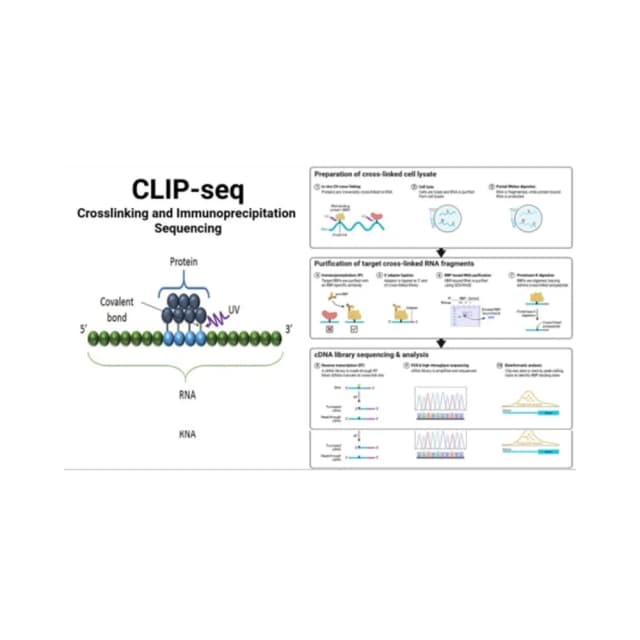
Cross-Linking and Immunoprecipitation followed by sequencing (CLIP-seq) is a high-throughput method to study RNA-binding protein (RBP) interactions with target RNAs genome-wide. It overcomes the high background and inability to distinguish direct from indirect binding of RNA immunoprecipitation by UV-crosslinking RNA and protein in vivo into covalent bonds, ensuring detected interactions are direct and real. It has greatly advanced RNA biology, especially post-transcriptional regulation.
Principle Introduction
CLIP-seq UV-crosslinks RBPs to their bound RNA in vivo instantaneously and covalently, then immunoprecipitates the RBP–RNA complex, builds libraries, and sequences to precisely map RBP binding sites transcriptome-wide.
Literature
Scientific Reports published "Widespread binding of FUS along nascent RNA regulates alternative splicing in the brain." Using iCLIP in mouse brain, FUS bound widely along nascent pre-mRNA in a "sawtooth" pattern, weakly preferring GGU, and loss of FUS increased exon inclusion, indicating repression. Suppressed exons were flanked by FUS signal co-localizing with U2AF65; though FUS and TDP-43 sites barely overlapped, both regulate neurodevelopment/degeneration genes, revealing parallel ALS/FTLD pathways.
Experiment Flow
UV crosslinking and lysis
UV-crosslink RBP-RNA complexes, then lyse and sonicate the cells.
Immunoprecipitation
pull down the RBP with antibody-coupled beads and high-salt washes.
Dephosphorylation and ligation
partially digest RNA, dephosphorylate ends and ligate 3′ adapters.
SDS-PAGE purification and proteinase K
separate RNP complexes by SDS-PAGE, cut the band and free the RNA.
RT and library amplification
reverse transcribe to cDNA, amplify the library and check its size.
Sequencing
Illumina PE150 sequencing with at least 40 M reads per sample.
Bioinformatics
perform QC, alignment, peak calling, motif, binding and GO/KEGG analysis.
Sample Requirements
- log-phase, healthy, no contamination. - ≥3×10⁷ viable cells per project (e.g., ~3 15-cm dishes of HeLa), ≥5×10⁷ recommended. - for nuclear RBPs ≥300 μL dry volume; cytoplasmic ≥100 μL. - provide ≥1 pre-test tube (~1/10 amount) for antibody specificity. - harvest at 90% confluence; snap-freeze, -80℃, dry ice.
- ≥200 mg, prefer fresh. - rinse in cold saline, remove blood/fat/connective tissue. - mince ≤5 mm³ to prevent RNA degradation. - snap-freeze ≥1 min in liquid N2, then -80℃. - dry ice, or in Trizol with dry ice.
- young leaf, root tip, seedling preferred. - rinse and dry leaf, wrap in foil, snap-freeze; mince root into 1.5 mL tube, snap-freeze. - 2–3 replicates; dry ice.
Deliverables
Internal QC
fragment-size distribution, signal-to-noise, crosslink features (length, UV mutation).
Standard analysis
peak identification/annotation, motif, GO/KEGG enrichment.
Advanced analysis
differential binding, splicing integration with RNA-seq, multi-omics regulatory networks.
FAQ
antibody non-specific binding and incomplete RNase digestion; correction requires matched negative controls (IgG or knockout) for background subtraction, without which false peaks invalidate downstream analysis.
CLIP captures a crosslink instant, missing order/timing/cooperativity; strong signal may be stable structural or transient catalytic. Combine with dynamic transcriptome/splicing after RBP perturbation to infer causality.
