
Epigenomics
Decode non-sequence genetic modifications and explore how the environment shapes gene expression through these marks.
MeRIP-Seq
Methylated RNA Immunoprecipitation followed by high-throughput sequencing (meRIP-seq) — eukaryotic RNA molecules undergo various post-transcriptional chemical modifications that do not change the base sequence yet precisely regulate RNA splicing, transport, translation efficiency, and stability, forming an important gene-expression regulatory layer called the "epitranscriptome". Among RNA modifications, N6-methyladenosine (m⁶A) is the most abundant and conserved internal modification in eukaryotes, widely present in mRNA, lncRNA, circRNA, and other non-coding RNAs across animals, plants, and fungi. Combining high-throughput sequencing with immunoprecipitation, meRIP-seq enables high-throughput, sensitive detection of specific RNA methylation sites transcriptome-wide, becoming a core epitranscriptome technique. It is now widely applied—in animals, to reveal RNA-modification mechanisms in embryonic development, stem-cell differentiation, tumorigenesis, and neurodegeneration; in plants and agriculture, to dissect crop growth, stress response, quality formation, and heterosis, providing a theoretical basis and gene resources for molecular breeding and stress resistance.
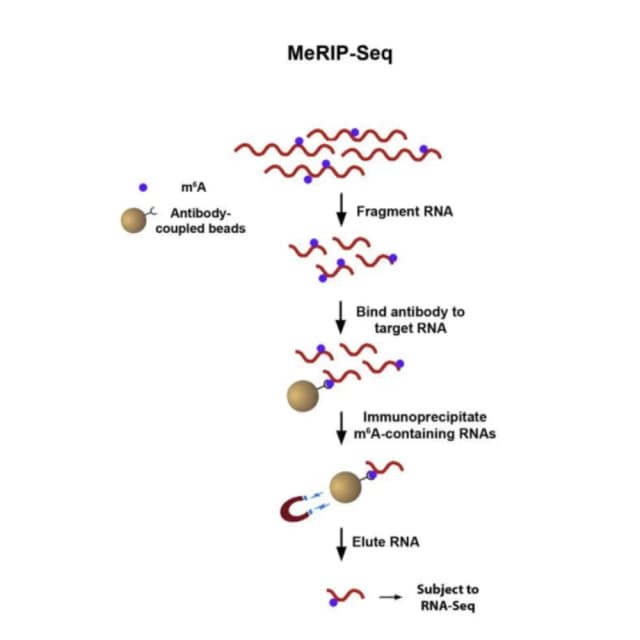
Principle Introduction
meRIP-seq uses a specific antibody to immunoprecipitate RNA fragments carrying the target methylation mark, then applies high-throughput sequencing to identify and quantify the modified sites transcriptome-wide. The workflow has four key steps, each directly affecting results. First, RNA extraction and preprocessing; second, the core immunoprecipitation enrichment; third, library construction and sequencing—the enriched modified RNA and Input control are reverse-transcribed, end-repaired, A-tailed, and adapter-ligated, then sequenced to generate reads; finally, bioinformatics analysis quality-controls raw reads, aligns high-quality reads to the reference genome/transcriptome, and compares IP vs Input sequencing depth to identify methylation-enriched regions (peaks), which are the candidate RNA methylation sites.
Literature
In Genomics Proteomics Bioinformatics, "Reversible RNA Modification N1-methyladenosine (m¹A) in mRNA and tRNA." reviewed the distribution and function of N1-methyladenosine (m¹A) in mRNA and tRNA. m¹A58 in tRNA is highly conserved, catalyzed by the TRMT6/61A complex, essential for tRNA structural stability, and erasable by the demethylase ALKBH1 to regulate translation initiation. In mitochondrial mRNA, m¹A lies mainly in coding regions, catalyzed by TRMT61B/TRMT10C, and inhibits mitochondrial protein translation by disrupting base pairing. The authors note that differing site counts across m¹A-seq studies may stem from technical bias in protocols. This work established m¹A as a second class of reversible RNA modification with dynamic regulatory roles in both cytoplasm and mitochondria.
Sample Requirements
at least 50 μg (for human/animal/complex samples); 100 μg+ recommended to ensure smooth MeRIP; some low-abundance samples may need more.
300 ng/μL or higher; higher is better to reduce volume and avoid over-dilution.
OD260/280: 1.9–2.1; OD260/230: ≥2.0. Low OD260/230 indicates salt/sugar/solvent residues that interfere with enzymatic reactions.
RIN ≥8.0; samples with RIN <7.0 are generally not recommended for m6A-seq.
use RNase-free ddH2O or Elution Buffer; avoid DEPC water, TE buffer (especially EDTA-containing), or other interfering buffers.
1.5 mL or 2.0 mL screw-cap cryotubes (thick-walled, well-sealed); label clearly with ID, concentration, volume, and total mass.
dry ice; maintain below −70°C throughout, with sufficient dry ice to cover transit plus buffer (e.g., 48 h of dry ice for 24 h transit).
Deliverables
Advanced analysis
differential methylation of genes/lncRNAs/circRNAs, GO/KEGG/Reactome enrichment of differentially methylated mRNAs, cis-target enrichment of differentially methylated lncRNAs, pathway analysis of differentially methylated circRNA host genes.
Custom analysis
association between m⁶A modification level and gene expression, quadrant plot of the "methylation–expression" relationship.
FAQ
Natural abundance and antibody affinity vary greatly across modifications, causing uneven IP efficiency and severe bias if compared directly. Advanced solutions build a composite reference system: spike in synthetic RNA of known modified sites/abundance, and select validated, stable endogenous sites as internal controls. Bioinformatics then uses quantitative models—spike-in-calibrated differential abundance algorithms or Bayesian hierarchical models—to correct technical variation and enable relative cross-modification comparison.
Use statistical tests to identify significantly co-occurring or mutually exclusive modification combinations, integrate RBP binding, RNA structure, and modifier localization to build condition-specific regulatory networks, and apply graph theory and machine learning to infer modification order and crosstalk.
