
Epigenomics
Decode non-sequence genetic modifications and explore how the environment shapes gene expression through these marks.
RIP-Seq
RIP-seq (RNA Immunoprecipitation sequencing) is a high-throughput sequencing technology for studying RNA–protein interactions, widely used to identify the RNA targets bound by a specific RNA-binding protein (RBP) across the transcriptome. RBPs play key roles in post-transcriptional regulation, including mRNA splicing, transport, stability, translation, and degradation. Defining their direct RNA targets in cells is essential to unravel RBP function and regulatory networks. Whereas CLIP (Crosslinking and Immunoprecipitation) relies on UV crosslinking to fix RNA–protein complexes, RIP-seq typically omits crosslinking (or uses mild formaldehyde crosslinking), making it suitable for studying stable RNA–protein complexes in their native state. Since its development in the late 2000s, RIP-seq has become a major tool for RBP–RNA interaction studies, especially for proteins forming stable complexes with RNA (e.g., ribosomal proteins, splicing factors, mRNA stability regulators).
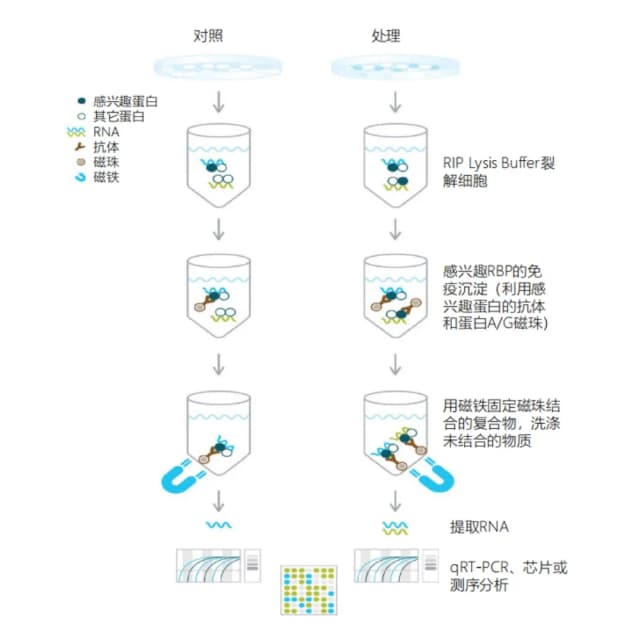
Principle Introduction
RIP-seq uses a specific antibody to enrich the target RBP and its bound RNA, then performs high-throughput sequencing on the co-precipitated RNA to identify the protein's binding sites or target RNAs transcriptome-wide. RIP-seq usually omits crosslinking or uses reversible crosslinking (e.g., formaldehyde), preserving native complexes but potentially including indirect binding.
Literature
In Molecular Cell, "Transcriptome-wide analysis of regulatory interactions of the RNA-binding protein HuR." combined PAR-CLIP and conventional RIP to map the transcriptome-wide interaction network of the RBP HuR (ELAVL1) in HeLa cells. The study identified ~26,000 high-confidence HuR binding sites, enriched in mRNA 3′UTRs and in classical AU-rich elements (ARE) and high-affinity motifs such as UUUUAUU and UAUUUAU. Notably, ~30–35% of sites lie in introns, are highly conserved, and sit near 3′ splice sites, suggesting HuR involvement in pre-mRNA splicing. Knockdown reduced mRNA and protein levels of thousands of targets, confirming its broad mRNA-stabilizing role. HuR sites neighbor but rarely overlap miRNA seeds, and HuR loss specifically upregulates miR-7, revealing a novel negative regulation of specific miRNAs and establishing HuR as a global mRNA stability regulator.
Sample Requirements
amount required
1 × 10⁷ cells
500 mg
1.0 g
Deliverables
Standard analysis
Peak identification and annotation, target gene functional enrichment, sequence motif analysis: de novo prediction of RBP-binding motifs matched against known databases.
Advanced analysis Multi-group comparison
differential binding site analysis. Splicing regulation association: spatial relationship between Peaks and alternative splicing events. Single-nucleotide resolution analysis: precise crosslink site maps for i/eCLIP data. Multi-omics integration: regulatory network construction with RNA-seq or public databases.
FAQ
RNA integrity matters throughout. Trace RNase contamination or failed inhibitors systematically degrade target RNA—especially affecting long transcripts or weak sites, introducing length bias and wasting precious samples. The entire workflow from lysis to purification must use certified RNase-free reagents and consumables under strict temperature control, with electrophoresis or bioanalyzer monitoring of Input and IP RNA integrity.
Classic RIP-seq captures RBP–RNA complexes in their native state with varying physical stability, reflecting broader physiological networks but inevitably including indirect binding mediated by other proteins or RNAs. Thus an identified peak is not itself a direct binding site; distinguishing direct from indirect requires downstream motif analysis, crosslinking validation, or functional tests such as site-directed mutagenesis.
