Epigenomics
Decode non-sequence genetic modifications and explore how the environment shapes gene expression through these marks.
WGBS
Whole-genome bisulfite sequencing (WGBS) is among the most comprehensive, highest-resolution DNA methylation methods, widely used in epigenetics, developmental biology and oncology. DNA methylation—mainly 5-methylcytosine (5mC) at the 5′ carbon of CpG cytosines—is the most common eukaryotic epigenetic mark. Without changing sequence, it regulates gene expression and drives cell differentiation, X-chromosome inactivation, imprinting and transposon silencing. Aberrant patterns link to cancer, neurodegeneration and autoimmunity. Traditional methods (methylation-specific PCR, MeDIP) lack coverage or resolution; WGBS with bisulfite treatment and high-throughput sequencing maps methylation genome-wide at single-base resolution.
Principle Introduction
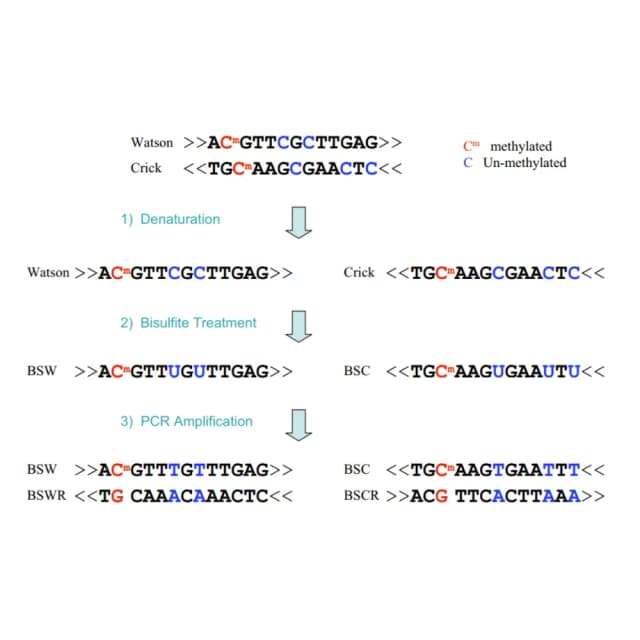
Sodium bisulfite deaminates unmethylated cytosines (C) to uracil (U), read as thymine (T) after PCR, while 5mC resists conversion. Comparing the reference with C→T conversions in reads identifies methylation at each C site.
Literature
Published in Cell Stem Cell, "Naïve human pluripotent cells feature a methylation landscape devoid of blastocyst or germline memory" used WGBS to compare DNA methylation among naïve hESCs (5iLAF or t2iL+Gö), in vivo blastocysts, oocytes and primed hESCs. Although naïve hESCs transcriptionally mimic the pre-implantation epiblast (high KLF, NANOG; low OTX2, ZIC) with global hypomethylation (CG near blastocyst), their methylation landscape diverged from true naïve state: failing to rebuild transient maternal imprints and losing methylation at all 31 stable imprinting control regions (e.g., H19, SNRPN), switching imprinting genes to biallelic expression. Their map correlated weakly with MII oocytes/blastocysts, showing in vitro culture erased gamete/embryo "methylation memory." Mechanistically, DNMT1/UHRF1 maintenance was suppressed while TET1/2 oxidases were upregulated, driving global demethylation and imprint erasure. The study warns that current naïve reprogramming achieves transcriptional but not faithful epigenetic reset, with implications for disease modeling and regenerative medicine.
Sample Requirements
≥2 μg pure DNA, RNA/protein removed; concentration ≥20 ng/μL by Qubit; prefer fresh or fresh-extracted DNA.
≥10–30 mg, rinsed in saline, dried, diced on ice, snap-frozen in liquid N₂, −80°C. Avoid RNAlater/TRIzol/alcohol.
≥2×10^6. Adherent cells digested and collected; suspend cells washed once in PBS, 600 g 5 min, snap-frozen, −80°C.
mammals ≥2 mL peripheral; nucleated RBC species ≥0.5 mL; EDTA tubes, no heparin; snap-frozen, −80°C. No RNAlater/TRIzol/alcohol.
≥15 sections, area ≥1 cm², 4–10 μm; tumor cells ≥30%; in 1.5/2.0 mL tubes.
for cfDNA analysis, >15 ng cfDNA with good fragment distribution, mononucleosome ≥50%; or 1–4 mL plasma/serum in specialized tubes. Note: bisulfite shortens cfDNA, lower library success—risk library only.
young leaves, ≥300 mg; polyphenol/polysaccharide plants need more or pre-extracted DNA; snap-frozen, −80°C. No chemicals.
≥100 ng DNA, ≥2 ng/μL by Qubit.
consult support first.
Deliverables
Standard analysis
single-base methylation levels; genome-wide and context (CpG, CHG, CHH) distribution; comparison across elements (promoter, exon, intron, repeat).
DMR identification
metilene/DSS/methylKit; DMR counts, length, direction.
Functional enrichment
DMR-linked genes (nearest TSS/overlap), GO and KEGG, imprinting and repeat analysis.
Advanced
multi-group/dynamic methylation, DMR clustering, trajectory visualization.
Multi-omics
with RNA-seq (promoter methylation vs. expression), ATAC-seq/ChIP-seq integration, allele-specific methylation, ASM via heterozygous SNP.
Custom visualization
IGV snapshots (key genes/ICR), Circos genome-wide map, Manhattan of DMRs.
FAQ
Targeted epigenetic editing can precisely restore site methylation to validate function; manipulating methylase activity revealed by WGBS probes mechanisms and guides culture optimization.
Methylation-expression conflicts reveal complex regulation (gene-body methylation linked to activation, allele-specific effects, 3D genome distant regulation). Integrating chromatin conformation and single-cell multi-omics clarifies heterogeneity.
