
Epigenomics
Decode non-sequence genetic modifications and explore how the environment shapes gene expression through these marks.
m6A-Seq
M6A-Seq (methylated RNA immunoprecipitation sequencing, meRIP-seq) uses specific antibodies to enrich N6-methyladenosine (m6A)-modified RNA fragments followed by high-throughput sequencing, identifying RNA methylation sites transcriptome-wide—a key technique for RNA epigenetic modification research.
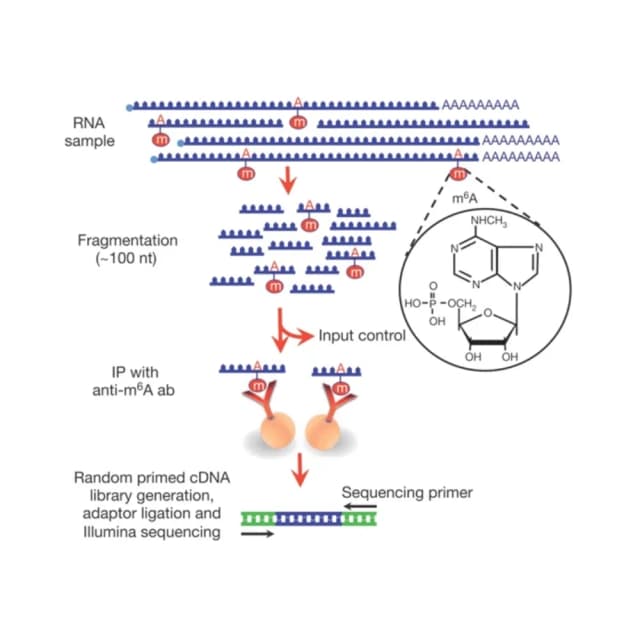
Principle Introduction
MeRIP-seq (m6A-seq) detects m6A sites transcriptome-wide. m6A is the most abundant internal modification in eukaryotic mRNA and non-coding RNA, regulating splicing, export, stability, and translation—a key epitranscriptomics tool. Total or poly(A) RNA is fragmented to ~100–200 nt; anti-m6A antibody immunoprecipitates modified fragments while a fraction is kept as Input. IP and Input are sequenced; comparing enrichment identifies m6A peaks genome-wide.
Experiment Flow
RNA extraction and fragmentation
extract total RNA, enrich mRNA and fragment it to proper length.
Immunoprecipitation
immunoprecipitate m6A RNA with anti-m6A antibody; Input kept as control.
Wash and elute
wash under strict conditions; elute with m6A nucleoside or TRIzol.
RNA purification
purify the immunoprecipitated and Input RNA with cleanup columns.
Library construction and sequencing
dephos, ligate adapters, reverse transcribe, PCR amplify and sequence.
Bioinformatics
perform QC, alignment, peak calling, motif and enrichment analysis.
Sample Requirements
genomic RNA, fresh-frozen tissue, cultured cells, plant samples.
≥100 μg pure RNA, protein/DNA removed; RIN >7; 28S:18S >1.5; OD260/280 1.6–2.3; no degradation; deproteinized and DNase treated.
≥500 mg, rinse in saline, blot, mince on ice, snap-freeze, -80℃.
≥3×10^7, wash once with PBS, 600 g 4℃ 5 min, discard supernatant, snap-freeze, -80℃.
young leaves etc., ≥5 g; increase for polyphenol/polysaccharide species or extract RNA first.
dry ice only.
Deliverables
Alignment results
mapping rate, read-depth cumulative plots, genomic/feature distribution tables.
Peak detection and annotation
peak files, genomic/feature distribution, distance-to-TSS plots.
Peak gene enrichment
GO/KEGG scatter, Top 20 pathways, differential-peak gene table.
Motif analysis
HOMER/MEME motifs around m6A sites and their positional plots.
Differential peaks
list, volcano, feature-distribution tables.
Differential enrichment and motif
GO/KEGG and motif enrichment in differential peaks.
Final report
m6A-seq PDF with IGV guide, methods, all attachments.
FAQ
The platform also applies to m7G, m5C, ac4C, etc.—just swap the specific antibody; workflow and analysis are identical.
