Metabolomics
Capture the direct signals of phenotypic change through precise metabolite quantification — a direct readout of physiological status.
Sphingolipidomics
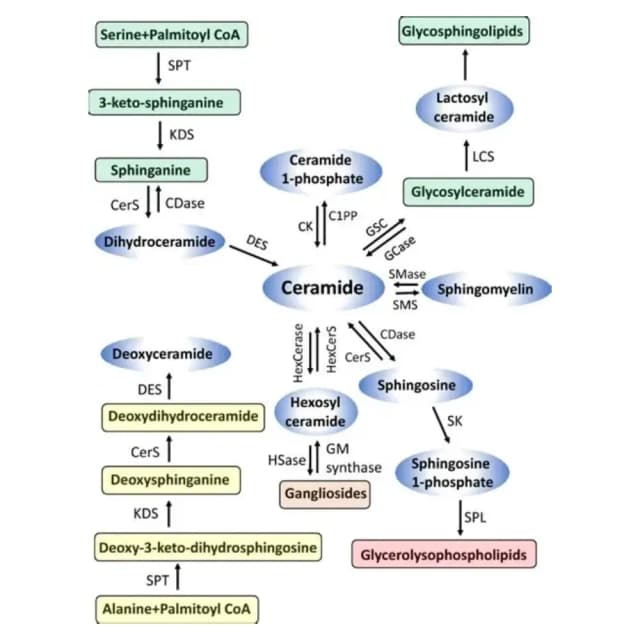
Sphingolipidomics is a key branch of lipidomics dedicated to the comprehensive profiling, quantification, and functional analysis of sphingolipids. As essential membrane components and bioactive signaling molecules, sphingolipids include ceramide (Cer), sphingosine (Sph), sphingosine-1-phosphate (S1P), sphingomyelin (SM), and glycosphingolipids such as glucosylceramide (GlcCer). Their dysregulation is implicated in apoptosis, insulin resistance, tumor progression and drug resistance, neurodegenerative diseases, atherosclerosis, and rare disorders (Gaucher, Niemann-Pick). LC-MS/MS-based ceramide profiling and ceramide analysis enable simultaneous quantification of hundreds of sphingolipid subspecies and capture dynamic shifts such as the Sph/S1P rheostat. Sphingolipidomics is now widely applied in oncology, metabolism, neuroscience, and drug mechanism studies.
Principle Introduction
Sphingolipidomics analysis follows an 'extraction–separation–quantification' workflow: 1. Extraction: total sphingolipids are co-extracted using MTBE/MeOH, Bligh-Dyer, or Folch methods, followed by solid-phase cleanup to remove proteins and phospholipids; 2. Separation: C18 reversed-phase or HILIC (hydrophilic interaction chromatography) resolves sphingolipids by polarity, acyl-chain length, and head group; 3. Detection & quantification: triple-quadrupole MS (MRM) or high-resolution MS (HRMS) enables accurate identification via precursor–product ion pairs and retention time, with isotope internal standards correcting matrix effects. Ceramide subspecies (C16:0, C18:0, C24:0, C24:1, etc.) are quantified and annotated against LIPID MAPS, HMDB, and in-house libraries.
Literature
Published in Journal of Diabetes and its Complications, 'Role of ceramides in the pathogenesis of diabetes mellitus and its complications' used sphingolipidomics to elucidate the central role of ceramides in diabetes and its complications. Serum, kidney, and vascular tissues from healthy, diabetic, and complication subjects were analyzed by UHPLC-MS/MS sphingolipidomics. Multiple ceramide subtypes showed abnormal accumulation, more pronounced in complication patients; ceramide imbalance disrupted insulin signaling and promoted apoptosis, aggravating target-organ damage. The study identifies ceramides as a key metabolic mediator linking diabetic pathology to complications.
Sample Requirements
≥200μL/sample (≥500μL for some panels), EDTA or heparin anticoagulated, sealed at -80°C and shipped on dry ice; fasting collection recommended, avoid freeze-thaw cycles
animal tissue ≥50mg, plant/microbe ≥100mg, flash-frozen in liquid nitrogen, stored at -80°C and shipped on dry ice; specify tissue site and treatment
≥1×10⁶, flash-frozen in liquid nitrogen, stored at -80°C and shipped on dry ice
CSF ≥100μL, urine ≥1mL, breast milk ≥500μL, stored at -80°C and shipped on dry ice
avoid freeze-thaw cycles; collect serum fasting when possible; record sampling time and handling; state anticoagulant for plasma
Deliverables
Raw data
LC-MS raw spectra, sphingolipid retention times, characteristic ion peaks, and peak-area quantification data
Identification & quantification
absolute/relative quantification tables grouped by class (Cer, Sph, S1P, SM, GlcCer, etc.)
Pathway & differential analysis
volcano plots, heatmaps, and KEGG sphingolipid metabolism pathway enrichment
Optional advanced analysis
subspecies ratios, ceramide/S1P ratio, and clinical correlation analysis
FAQ
Ceramides with different chain lengths and saturation behave distinctly: short-chain C16:0 often drives pro-apoptotic signaling, while long-chain C24:0/C24:1 enrich in neural tissue and associate with neurodegeneration; ceramide profiling in tumors can reveal abnormal accumulation or depletion of specific subspecies.
Freeze-thaw cycles, heat, or acidic conditions can drive SM hydrolysis to Cer, Cer deacylation to Sph, and Sph phosphorylation to S1P, disrupting the Sph/S1P rheostat. Samples must be kept at -80°C and shipped on dry ice without delay.
Compared with Bligh-Dyer and Folch methods, MTBE (methyl tert-butyl ether/methanol/water) gives cleaner phase separation, higher lipid recovery, better removal of polar impurities, and efficient co-extraction of ceramides—making it the preferred sample-prep for sphingolipidomics.
