
Metabolomics
Capture the direct signals of phenotypic change through precise metabolite quantification — a direct readout of physiological status.
Untargeted Metabolomics
Untargeted metabolomics (also discovery metabolomics) is a bias-free, simultaneous analysis of all small-molecule metabolites, profiling the total metabolome of biological samples and quantifying differences across treatment or physiological groups to find altered metabolites for mechanistic study. High-throughput detection comprehensively surveys endogenous metabolites, reflecting metabolic changes under physiological or pathological states and providing clues for disease mechanisms and biomarker discovery.
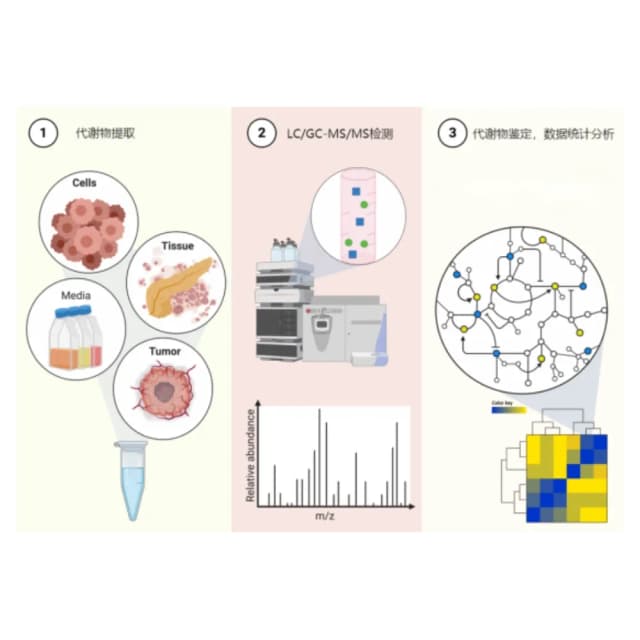
Principle Introduction
LC-MS untargeted metabolomics includes experimental detection and data analysis. Experiments cover design, sample preparation, metabolite extraction and detection; analysis covers differential-metabolite screening and pathway analysis. Each step is standardized to ensure high-quality data. Analysis includes multivariate and univariate statistics, differential screening and pathway analysis.
Literature
In "Knowledge and data-driven two-layer networking for accurate metabolite annotation in untargeted metabolomics" (Nature Communications), the MetDNA3 framework addressed low annotation efficiency and limited coverage. Integrating a knowledge network (graph-neural-network predicted reactions) with a data network (MS experiments) via pre-mapping and recursive propagation, it avoided redundant parent-ion matching. Versus MetDNA2, efficiency rose ~14× (1,082→77 min); annotation coverage reached 68.1% and accuracy 84.4%, annotating 1,652 seed and >12,500 potential metabolites (9,410 known, 3,098 unknown), expanding metabolome coverage for disease and biomarker research.
Sample Requirements
≥200 mg
≥200 μL
≥200 μL
≥200 mg
≥200 mg
≥200 μL
pellet wet weight ≥200 mg
Deliverables
QC report
sample quality (extraction yield, recovery, purity); MS quality (feature-peak count, Q30, mass accuracy); preprocessing quality (peak alignment, replicate correlation, QC clustering).
Metabolite identification & annotation
list (name, MW, formula, RT, MS2 score); quantitative matrix (peak area/height, normalized abundance, FC, P, VIP); HMDB/METLIN/KEGG/NIST annotation; differential list, volcano/heatmap, PCA/OPLS-DA scores.
Functional analysis
KEGG enrichment (Top20) and pathway maps; metabolite association network; ROC-based biomarker selection.
Interpretation report
overall metabolome differences, key differential metabolites, core pathways, biomarker candidates; phenotype association and metabolic-reprogramming hypotheses; suggestions for validation and multi-omics.
FAQ
Hemolysis releases hemoglobin/lactate and inhibits ionization; lipemia interferes with separation. Avoid by gentle handling, prompt centrifugation, excluding such samples; otherwise use hemoglobin-removal kits or ultracentrifugation.
Exact-mass match; MS2 database score ≥80; RT deviation ≤0.2 min vs standards; cross-platform confirmation; confidence tiers (confirmed/high-confidence/putative).
