
Proteomics
Dissect the proteome to uncover key biomarkers and decode the mechanisms of life from the terminal executors of function.
Astral-DIA Proteomics
Astral-DIA proteomics is based on the new-generation OrbitrapTM AstralTM high-resolution mass spectrometer, combining a quadrupole, an Orbitrap and a novel asymmetric track lossless mass analyzer for higher throughput, deeper coverage and greater sensitivity. It enables large-scale proteomics and deep coverage of species-wide proteome maps, advancing understanding of protein function and regulation. Versus conventional DIA (incl. 4D-DIA), Astral-DIA delivers breakthrough throughput, extreme sensitivity and precise quantification.
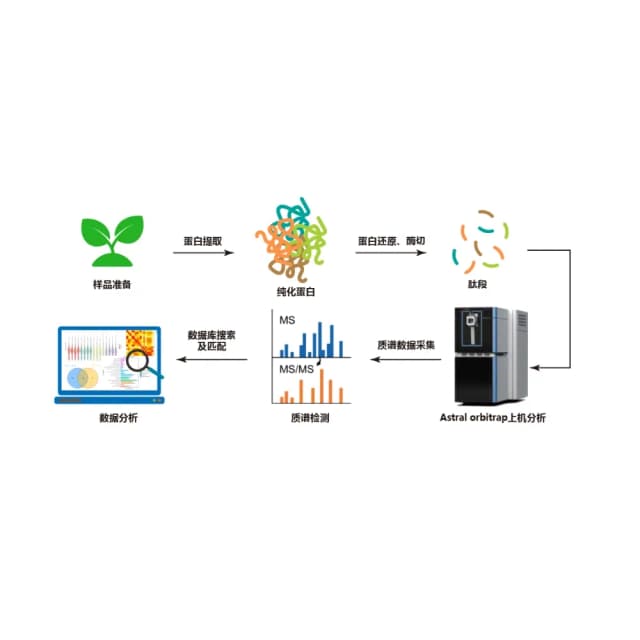
Principle Introduction
Astral-DIA first quality-assesses and pre-processes the search-derived qualitative/quantitative data, then performs expression-level and functional analysis, annotating identified proteins via common databases. Differential proteins undergo GO, pathway and interaction analysis, visualized by volcano plots, expression-cluster heatmaps and Venn diagrams. Based on data traits, researchers may select proteins of interest and their functions/pathways for follow-up validation.
Literature
In "The astounding exhaustiveness and speed of the Astral mass analyzer for microbiomes" (Microbiome), Astral-DIA profiled human gut and soil microbiomes, mining functional genes and metabolic pathways. A single gut sample yielded 18,760 proteins across 1,200 species (incl. 150 low-abundance taxa at <0.1%); soil yielded 21,340 proteins with annotated nitrogen-cycle (nifH) and antibiotic-resistance (ermF) genes. A 30-min gradient analyzed one microbiome sample—70% faster than conventional DIA—and protein abundance linked Bifidobacterium polysaccharide-degrading enzymes (GH43) to host fiber intake (r=0.72), enabling rapid functional microbiome解析.
Deliverables
QC report
sample quality (protein yield, peptide recovery, SDS-PAGE); acquisition quality (Astral scan speed ≥200 Hz, DIA window coverage, Q30, peptide IDs); quantification quality (protein CV, missing-value rate, replicate correlation); special metrics (single-cell sorting efficiency, microbial host-contamination rate).
Protein quantification & annotation
expression matrix (FPKM/Intensity or reporter intensity, with log2FC, P, FDR); differential list, volcano/heatmap; UniProt annotation, subcellular localization, domains, PTM sites; single-cell t-SNE/UMAP clusters, microbial species–function table.
Functional analysis
GO/KEGG/Reactome enrichment (Top20); STRING PPI network with core nodes; customized ROC or metabolic-activity scores.
Interpretation report
key differential proteins, pathway hubs, sample heterogeneity (single-cell/microbiome); biological significance and Astral-DIA advantages.
FAQ
Yes—the only DIA technology supporting TMTpro 32-plex: 16- or 32-plex (31 samples + 1 QC per 32-plex), labeling efficiency ≥98%; ideal for large clinical cohorts (10 batches of 32) or multi-timepoint studies.
They compete for ionization, lowering microbial protein IDs by 20–30%. Remove with host DNA/RNA depletion kits (≥95%), extend digestion to 20 h, and use a microbiome-specific database; post-treatment host contamination ≤5% and microbial IDs rise ~40%.
