Proteomics
Dissect the proteome to uncover key biomarkers and decode the mechanisms of life from the terminal executors of function.
Peptidomics
Peptidomics analysis systematically identifies, characterizes and functionally associates endogenous peptides (typically 3–50 amino acids) in a sample, focusing on peptides from proteolysis (enzymatic or autophagic) or active cellular secretion—signal peptides, hormone peptides, antimicrobial peptides and degradation intermediates. It directly reflects the dynamic metabolic state of proteins. These peptides, generated by specific proteases under physiological or pathological conditions, perform signaling, immune recognition and enzymatic regulation.
Principle Introduction
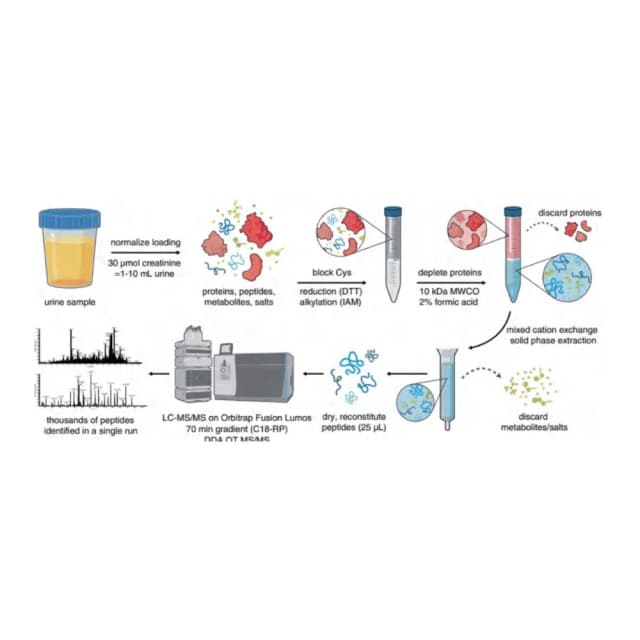
Peptidomics directly detects native endogenous peptides by high-resolution MS for identification, quantification and functional analysis. The logic: sample preparation, MS analysis, data computation. It is valuable for biomarker screening, drug development and immunotherapy. Workflow: sample pretreatment and peptide extraction, peptide separation, MS detection, data analysis and functional interpretation.
Literature
In "Single-Position Peptide Clustering for Peptidomics Reveals Novel Disease Biomarkers and Dysregulated Proteolytic Characteristics" (Advanced Science), a single-position peptide-clustering strategy addressed redundant-peptide noise. An amino-acid-score (aa-score) algorithm integrates redundant peptides from the same protein and feature site into a "single-position peptide cluster" as a functional unit, linking substrate proteins, protease activity and disease mechanisms. In β-thalassemia, novel peptide-cluster biomarkers were found and AHSG proteolytic dysregulation revealed, providing a new analytical framework for peptidomics in diagnosis.
Sample Requirements
fresh ≥100 mg (animal) or ≥300 mg (plant);
adherent ≥5×10⁶; suspension ≥1×10⁷;
serum/plasma ≥2 mL (routine) or ≥5 mL (low-abundance); CSF ≥1 mL, urine ≥10 mL; saliva ≥3 mL (fasting), sweat ≥5 mL;
peptide ≥10 μg, concentration ≥0.5 μg/μL.
Deliverables
QC report
sample quality (peptide yield, recovery, purity); MS quality (peptide IDs, Q30, peptide FDR); identification quality (coverage, fragment-ion matches, PTM confidence).
Peptide identification & annotation
high-confidence list (name, MW, sequence, source protein, score); modification results (type, site, confidence); annotation (source-protein function, bioactivity, localization, disease association); differential peptide list (abundance, FC, P, FDR).
Functional analysis
peptide classification by bioactivity/source function; GO/KEGG enrichment (Top20) of source proteins; bioactivity prediction from sequence/domains.
Interpretation report
main peptide categories, key differential peptides, bioactive candidates; biological significance.
FAQ
Add de-modification inhibitors; enrich phospho-peptides with TiO₂, glyco-peptides with lectin; enable modification search; set PTM confidence threshold.
HPLC retention-time/peak-area and PRM confirmation, Western blot/ELISA; then in vitro and in vivo bioactivity assays.
Snap-freeze in liquid nitrogen; add PVP and β-mercaptoethanol with CTAB; ethanol/sevage de-sugaring/de-phenoling; 3 kDa ultrafiltration; C18 desalting before MS.
