
Proteomics
Dissect the proteome to uncover key biomarkers and decode the mechanisms of life from the terminal executors of function.
Pan-Modification Proteomics
Pan-modification Proteomics is a core sub-service of quantitative modification proteomics, focusing on protein comprehensive multi-class PTM analysis. Leveraging high-throughput MS detection and specific enrichment (combinatorial multi-antibody IP enrichment), it captures and quantifies 多類型 modified peptides at Ser/Thr/Tyr/Lys/Cys 多位點, systematically identifying modification sites, screening differentially modified proteins, and deciphering the signaling pathways and biological functions of modification regulation. Widely applied to disease-mechanism research (e.g., oncology, cardiovascular, neurodegenerative diseases), drug-target discovery, biomarker screening, and multi-omics integration, it supports clinical translation and precision medicine as a key technique for revealing 'dynamic protein functional regulation'.
Principle Introduction
The core of Pan-modification Proteomics is to enrich target modified peptides using specific antibodies or chemical-affinity reagents, combined with LC-MS/MS detection on a high-resolution MS platform (Orbitrap Astral / timsTOF Pro 2) and label-free or metabolic-labeling quantification (SILAC / TMT) strategies, achieving precise modification-site identification and inter-group differential analysis. For the chemical properties of comprehensive multi-class PTM analysis, a dedicated enrichment method (combinatorial multi-antibody IP enrichment) is used; modification-site localization probability ≥75% is classified as high confidence (Class I), with strict FDR <1% filtering, plus downstream functional analysis including GO/KEGG pathway enrichment, kinase–substrate prediction, and PPI network.
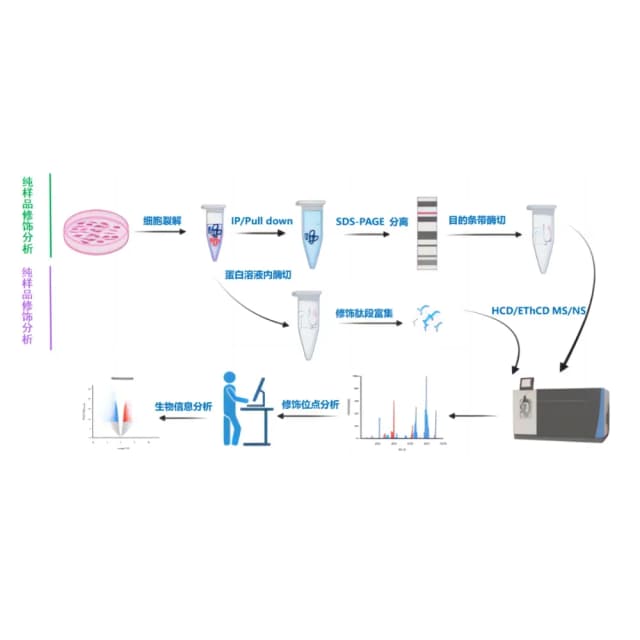
Experiment Flow
Sample prep & protein extraction
lyse cells, quantify protein, reduce, alkylate and digest to peptides.
Modified-peptide enrichment
enrich modified peptides via TiO₂/IMAC, IP and lectin affinity methods.
LC-MS/MS detection
detect peptides on Orbitrap Astral / timsTOF Pro 2 MS via DIA/DDA.
Data analysis
identify sites (FDR), screen differential sites, GO/KEGG/Reactome, PPI.
Modification regulation
analyze up/down pathways, kinase-substrate relations and conservation.
Sample Requirements
common animal tissues (liver, heart, brain, skin, kidney, intestine, muscle, various glands, etc.) ≥10 mg (risk 5 mg); for human clinical tissue samples ≥10 biological replicates recommended, common animal tissues ≥3 biological replicates;
adherent cells ≥5×10⁶, suspension cells ≥1×10⁷;
serum/plasma ≥100 μL (risk 50 μL), urine ≥1 mL (risk 0.5 mL), cerebrospinal fluid ≥1 mL;
total protein ≥100 μg, total peptide ≥50 μg;
flash-freeze in liquid nitrogen, store at -80℃ (≤3 years); aliquot into multiple tubes to avoid repeated freeze-thaw; ship on dry ice.
Deliverables
Data QC report
sample quality (protein extraction yield, peptide recovery ≥80%, modified-peptide enrichment efficiency ≥50%); MS detection quality (number of modified sites identified, peptide matching score, Q30 ratio); quantification quality (modification-site CV, biological-replicate correlation, differential-modification-site screening criteria);
Modification quantification & annotation
quantification matrix (expression level, FC, P value, FDR of modified sites); differential analysis results (differential modified-site list, volcano plot, heatmap clustered by function/pathway); database annotation (site amino-acid type, sequence position, protein function description, known modification–function associations);
Functional analysis results
GO/KEGG/Reactome pathway-enrichment scatter plot (Top 20 pathways), STRING database PPI network (highlighting core differential modified proteins and interactions), modification-regulation analysis (kinase–substrate relationship prediction);
Analysis & interpretation report
core differential modified-site set, potential biomarker/target candidates, association strength with disease/phenotype; interpretation of core-site functional mechanisms and clinical/research significance.
FAQ
Improve detection through sample pretreatment, enrichment optimization, and MS parameter tuning: ①Sample level: increase starting sample amount and use high-activity digestion reagents to extend digestion time; ②Enrichment level: adopt pre-enrichment + secondary enrichment to reduce non-specific peptide interference; ③MS level: increase sequencing depth, use high-resolution MS, and extend gradient elution time.
Quantification accuracy is ensured by technical design and experimental validation. ①Technical: add isotope-labeled internal standards during enrichment to correct enrichment-efficiency bias; MS quantification uses "peptide-intensity normalization" to ensure inter-group comparability; ②Experimental: select 10–20 differential modification sites for PRM validation, achieving >80% consistency.
Screen functional modification sites through multi-dimensional validation. ①Conservation analysis: use databases such as PhosphoSitePlus and UniProt to verify conservation of the modification site across homologous proteins; ②Functional association: check whether the site has been reported or overlaps with a known functional domain; ③Experimental validation: introduce site mutations or overexpress the modifying enzyme and measure changes in protein activity and cellular function to verify the modification's functional impact.
