Proteomics
Dissect the proteome to uncover key biomarkers and decode the mechanisms of life from the terminal executors of function.
Metaproteomics
Metaproteomics is a technology for large-scale identification and quantification of the overall protein expression of microbial communities (gut, soil, marine, etc.). It overcomes the limitation of metagenomics—which only reflects 'functional potential'—and directly reveals the 'actual functional activity' of microbial communities at the protein level, including species composition, functional pathways, enzyme activity, and host–microbe interaction analysis.
Principle Introduction
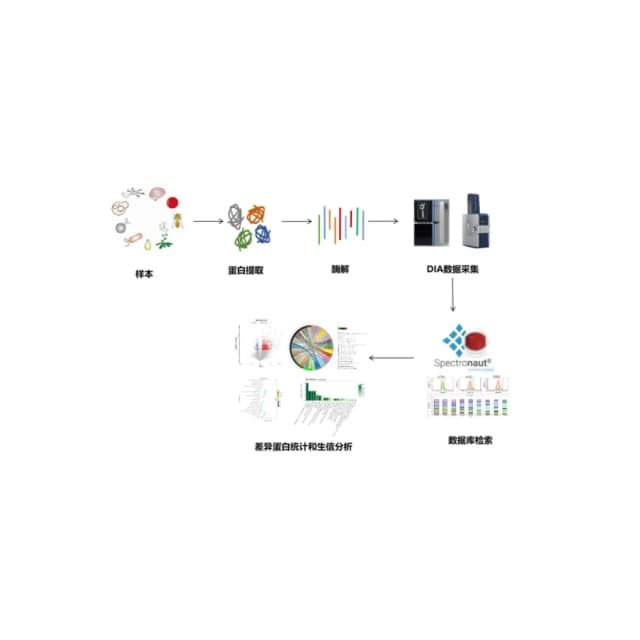
Microbial samples (e.g., feces, soil) are pretreated to remove host contamination, then proteins are extracted and digested, fractionated by HPLC, and analyzed by high-depth LC-MS/MS (combined DDA + DIA). Database searching uses an integrated microbial-specific protein database (UniProt + custom metagenome library) for species–function association analysis and metabolic-pathway activity scoring.
Experiment Flow
Sample pretreatment & protein preparation
lyse tissue or cells, reduce, alkylate and digest protein to peptides.
Peptide purification & fractionation
desalt peptides on C18, dry by vacuum and fractionate by HPLC.
LC-MS/MS detection
couple nano-flow HPLC with high-resolution MS in DDA or DIA mode.
Database search & quantification
search the database with FDR <1% control and output quantification.
Bioinformatics analysis
screen proteins, perform GO/KEGG, PPI and heat/volcano visualization.
Sample Requirements
common animal tissues (liver, heart, brain, skin, kidney, intestine, muscle, various glands, etc.) ≥10 mg (risk 5 mg); for human clinical tissue samples ≥10 biological replicates recommended, common animal tissues ≥3 biological replicates;
adherent cells ≥5×10⁶, suspension cells ≥1×10⁷;
serum/plasma ≥100 μL (risk 50 μL), urine ≥1 mL (risk 0.5 mL), cerebrospinal fluid ≥1 mL;
total protein ≥100 μg, total peptide ≥50 μg;
flash-freeze in liquid nitrogen, store at -80℃ (≤3 years); aliquot into multiple tubes to avoid repeated freeze-thaw; ship on dry ice.
Deliverables
Data QC report
sample quality (protein extraction yield, peptide recovery); MS detection quality (number of peptides identified, number of proteins identified, Q30 ratio, protein-identification FDR);
Protein quantification & annotation
quantitative expression matrix (FPKM/Intensity, FC, P value, FDR); differential-protein list, volcano plot, heatmap; database annotation (UniProt + custom metagenome library);
Functional analysis results
GO/KEGG pathway enrichment (Top 20), PPI network, differential-protein clustered heatmap; multi-omics association analysis (optional);
Analysis & interpretation report
core conclusions (key protein set, potential biomarkers, key regulatory pathways); interpretation of results (functional mechanisms of core proteins and their association with disease/phenotype).
FAQ
Choose based on research goals: ①DIA (4D-DIA / Astral-DIA): high throughput, accurate quantification, broad coverage—ideal for large-scale discovery / large cohorts; ②DDA (PRM / modification quantification): high sensitivity and accurate modification-site localization—ideal for targeted validation and modification proteomics; ③TMT labeling: can quantify up to 16 samples simultaneously—ideal for medium-scale cohorts; ④Label-free: no labeling required, flexible—ideal for small samples and mixed multi-type sample studies.
Core of multi-omics integration: ①Sample consistency: must use samples from the same source and same batch processing to avoid association bias from sample differences; ②Regulation-direction matching: focus on molecules whose protein-expression trends are consistent with or complementary to mRNA—mRNA showing no difference but protein up-regulated suggests post-translational regulation; ③Pathway focus: take pathways co-enriched across multi-omics to lock in the core regulatory axis; ④Tool support: use Metascape, String, etc. to build an "mRNA–protein–metabolite" network.
