
Proteomics
Dissect the proteome to uncover key biomarkers and decode the mechanisms of life from the terminal executors of function.
Tyrosine Methylation Proteomics
Tyrosine methylation proteomics uses high-resolution mass spectrometry to systematically identify and quantify methylation on tyrosine (Tyr) residues, revealing its roles in signal transduction, protein interaction, and disease—an important direction in PTM research.
Principle Introduction
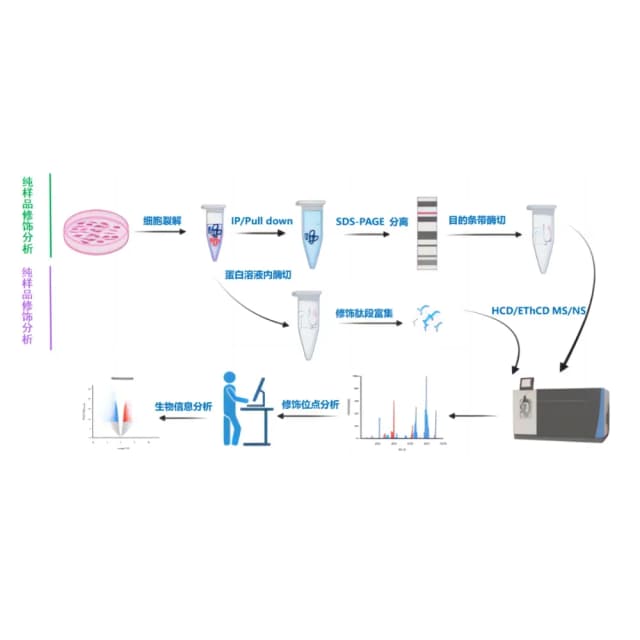
Tyrosine methylation proteomics follows the general PTM workflow: anti-Tyr-methylation antibodies immunoprecipitate modified peptides, then high-resolution MS (Orbitrap Astral / timsTOF Pro 2) with LC-MS/MS and label-free or SILAC/TMT quantification identifies and compares Tyr-methylation sites. Sites with localization probability ≥75% are high-confidence (Class I); FDR <1% strict filtering, with downstream GO/KEGG and PPI analysis. Note: no dedicated Tyr-methylation protocol document yet; refer to the general PTM workflow.
Experiment Flow
Sample preparation
lyse and BCA-quantify protein, reduce, alkylate and digest with trypsin.
Modified-peptide enrichment
enrich modified peptides by anti-Tyr-Me IP with efficiency ≥50%.
LC-MS/MS
analyze enriched peptides on Orbitrap Astral / timsTOF Pro 2 via DIA/DDA.
Data analysis
identify sites with FDR, find differential sites and GO/KEGG/Reactome.
Regulation analysis
analyze upstream/downstream pathways and modified-site conservation.
Sample Requirements
animal tissue, cells, plant tissue, mollusk, insect, body fluid, etc.
80 mg (risk 40 mg), rinse in cold PBS, remove fat/connective, 1 cm³ blocks, snap-freeze 5 min, -80℃, dry ice; ≥3 replicates, ≥10 for human clinical.
8×10^7 (risk 2×10^7), snap-freeze 1 min, -80℃, dry ice (HeLa reference).
800 mg (risk 500 mg).
5 g (risk 3 g); pulp: 100 g (risk 50 g).
serum/plasma consult pre-sales (intact glycopeptide 100 μL).
5 mg (risk 2 mg).
-80℃ within 3 yr, aliquot, dry ice.
Deliverables
QC report
sample quality (yield, peptide recovery ≥80%, Tyr-Me enrichment ≥50%); MS quality (site count, PSM score, Q30); quantification quality (CV, replicate correlation, screening criteria).
Quantification and annotation
matrix (Tyr-Me intensity, FC, P, FDR); differential list, volcano, heatmap; database annotation (residue, position, function).
Functional analysis
GO/KEGG/Reactome scatter (Top 20), STRING PPI, regulation analysis.
Interpretation report
core Tyr-Me sites, potential markers/targets, disease/phenotype association, mechanistic significance.
