Proteomics
Dissect the proteome to uncover key biomarkers and decode the mechanisms of life from the terminal executors of function.
Drug-Target Proteomics
Drug-target proteomics integrates quantitative proteomics (Label-free/DIA/TMT) with chemoproteomics strategies (e.g., Thermal Proteome Profiling TPP, Activity-Based Protein Profiling ABPP) to systematically identify drug directly-bound target proteins, off-target effects, and target-involved pathways, covering the full chain of drug-target discovery, MoA elucidation, and clinical translation.
Principle Introduction
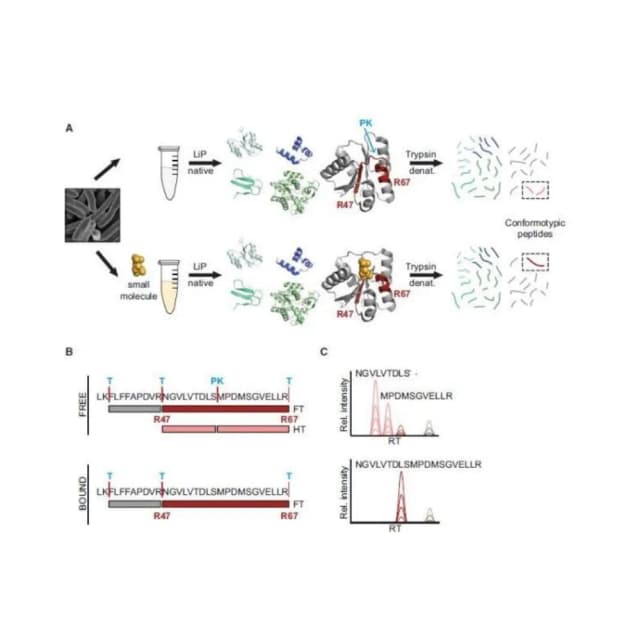
After drug treatment of cell/tissue samples, proteins are extracted and digested; chemoproteomics methods (TPP/ABPP, etc.) process the samples, which are then analyzed by high-resolution LC-MS/MS. Targets are identified via dose–response melting curves or competitive-binding analysis, and combined with PPI networks and pathway-enrichment analysis to localize core target proteins and regulatory networks.
Experiment Flow
Sample pretreatment & protein preparation
lyse tissue or cells, reduce, alkylate and digest protein to peptides.
Peptide purification & fractionation
desalt peptides on C18, dry by vacuum and fractionate by HPLC.
LC-MS/MS detection
couple nano-flow HPLC with high-resolution MS in DDA or DIA mode.
Database search & quantification
search the database with FDR <1% control and output quantification.
Bioinformatics analysis
screen proteins, perform GO/KEGG, PPI and heat/volcano visualization.
Sample Requirements
common animal tissues (liver, heart, brain, skin, kidney, intestine, muscle, various glands, etc.) ≥10 mg (risk 5 mg); for human clinical tissue samples ≥10 biological replicates recommended, common animal tissues ≥3 biological replicates;
adherent cells ≥5×10⁶, suspension cells ≥1×10⁷;
serum/plasma ≥100 μL (risk 50 μL), urine ≥1 mL (risk 0.5 mL), cerebrospinal fluid ≥1 mL;
total protein ≥100 μg, total peptide ≥50 μg;
flash-freeze in liquid nitrogen, store at -80℃ (≤3 years); aliquot into multiple tubes to avoid repeated freeze-thaw; ship on dry ice.
Deliverables
Data QC report
sample quality (protein extraction yield, peptide recovery); MS detection quality (number of peptides identified, number of proteins identified, Q30 ratio, protein-identification FDR);
Protein quantification & annotation
quantitative expression matrix (FPKM/Intensity, FC, P value, FDR); differential-protein list, volcano plot, heatmap; database annotation (UniProt + custom metagenome library);
Functional analysis results
GO/KEGG pathway enrichment (Top 20), PPI network, differential-protein clustered heatmap; multi-omics association analysis (optional);
Analysis & interpretation report
core conclusions (key protein set, potential biomarkers, key regulatory pathways); interpretation of results (functional mechanisms of core proteins and their association with disease/phenotype).
FAQ
Choose based on research goals: ①DIA (4D-DIA / Astral-DIA): high throughput, accurate quantification, broad coverage—ideal for large-scale discovery / large cohorts; ②DDA (PRM / modification quantification): high sensitivity and accurate modification-site localization—ideal for targeted validation and modification proteomics; ③TMT labeling: can quantify up to 16 samples simultaneously—ideal for medium-scale cohorts; ④Label-free: no labeling required, flexible—ideal for small samples and mixed multi-type sample studies.
Core of multi-omics integration: ①Sample consistency: must use samples from the same source and same batch processing to avoid association bias from sample differences; ②Regulation-direction matching: focus on molecules whose protein-expression trends are consistent with or complementary to mRNA—mRNA showing no difference but protein up-regulated suggests post-translational regulation; ③Pathway focus: take pathways co-enriched across multi-omics to lock in the core regulatory axis; ④Tool support: use Metascape, String, etc. to build an "mRNA–protein–metabolite" network.
